
Data Formats & Compatibility
Methodological standards, quality checks, independent expert review and quality principles for HiQLCD.
Data Formats & Compatibility
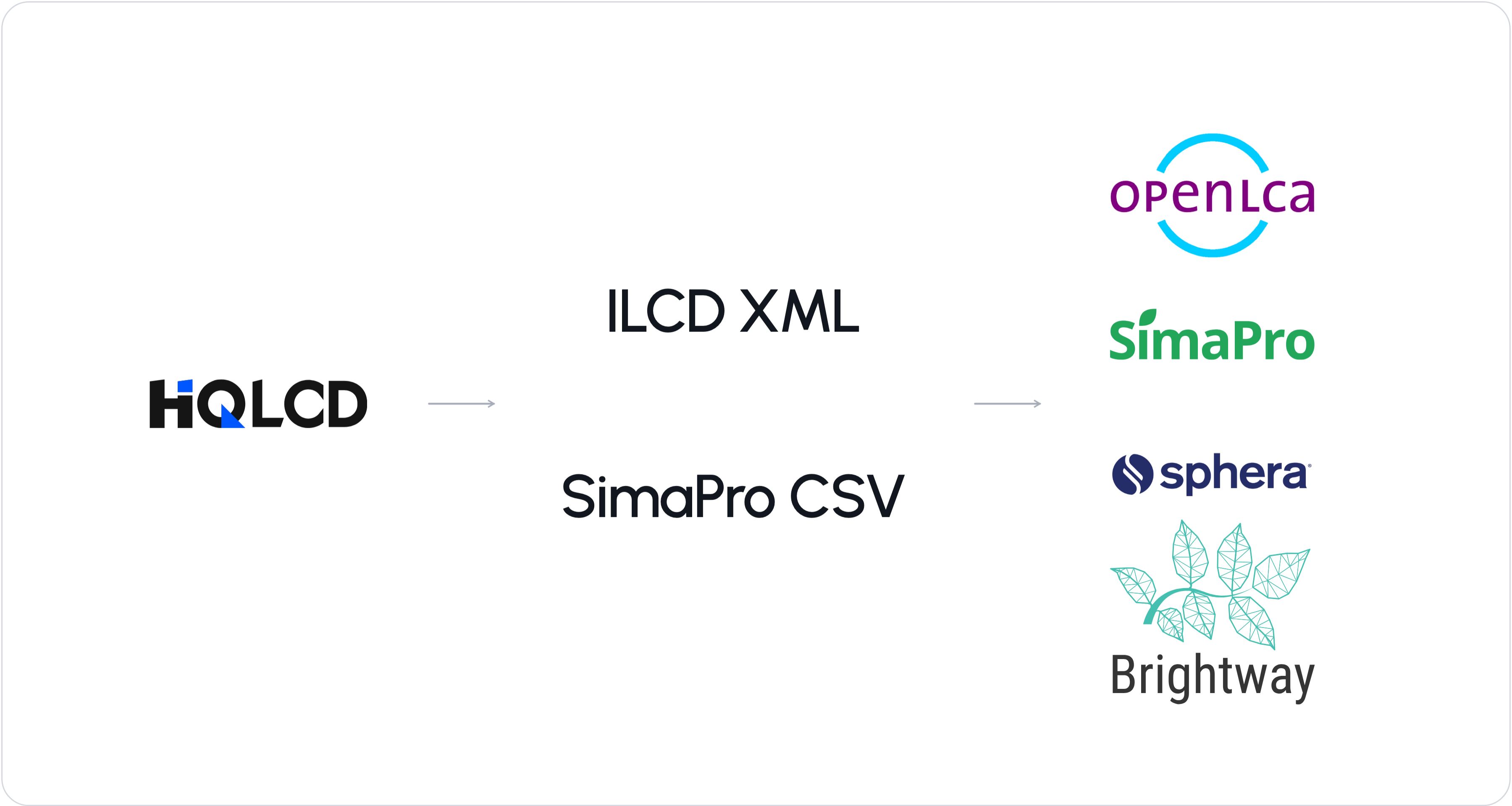
HiQLCD supports widely used LCA tools, including openLCA, SimaPro, Sphera LCA for Experts (formerly GaBi) and Brightway, through compatible data formats and delivery arrangements. Compatibility may vary by software version and data format. Our team can help confirm the appropriate format for your workflow.
Methodological Standards
Developed in accordance with ILCD format requirements, the HiQLCD Database is a comprehensive Chinese LCA background database that provides global users with high-quality data reflecting China's industrial conditions. Its methodological framework is consistent with ISO 14040 and ISO 14044 and meets quality requirements across multiple dimensions:
| Standard / Method | Description |
|---|---|
| ILCD | HiQLCD datasets strictly follow the ILCD data format and have passed validation with the official ILCD Validation Tool. They can be downloaded and directly imported into professional LCA software such as openLCA, SimaPro, GaBi, and Brightway. |
| ISO 14040 / ISO 14044 | Data modeling fully complies with the core LCA methodology requirements of ISO 14040 and ISO 14044 and meets the requirements for specialized applications under ISO 14067, PEF, and other frameworks. |
| EN 15804 / ISO 21930 / ISO 14025 | HiQLCD complies with EN 15804, ISO 21930, and ISO 14025, provides all inventory indicators required by EN 15804, follows the applicable end-of-waste criteria, and supports LCA modeling for EPD projects. |
| IPCC 2021, CML, EF, ReCiPe | The LCIA module includes built-in methods such as CML, EF, IPCC, and ReCiPe. Users can view all indicators available under each method and filter or search by category, indicator, or elementary-flow name. |
Quality Checks and Uncertainty
During data development, HiQLCD checks data completeness, consistency, and accuracy and conducts data-quality assessment and uncertainty analysis according to the characteristics of the data and model. Uncertainty analysis includes methods such as the pedigree matrix and Taylor series expansion. The quality indicators, analytical methods, and results applicable to a specific dataset are those displayed for that dataset and version.
Quality Control in HiQ Editor
HiQ Editor manages processes, flows, sources, locations, units, LCIA methods, contacts, versions, and other data elements in accordance with the ILCD data-format architecture. It provides standardized templates, bulk import, field mapping, data validation, role-based permissions, operation logs, and version management to support data standardization, traceability, and quality control.
Independent Expert Review
HiQLCD's general methodology, core-sector methodologies for steel, aluminum, and electricity, HiQ Editor, and representative datasets have undergone an independent expert review conducted by Professor Guido Sonnemann. The review followed the critical-review principles and procedures described in ISO 14071:2014, with appropriate adaptations for the review of life cycle inventory database methodologies.
Quality Principles
To ensure data reliability, we strictly follow four quality principles:
| Principle | Description |
|---|---|
| Representativeness | We account for differences in geography and production technology, use public company data, industry statistics, industry emission standards, and other verified sources, and document geographical, temporal, and technological representativeness. |
| Consistency | We apply consistent rules to data management, processing, and recordkeeping; manage fields and structures in the ILCD format; and organize datasets within the same industry using consistent methods. |
| Quality Assurance | The data-development process includes checks and validation for completeness, consistency, and accuracy. Dataset metadata and unit-process data are reviewed by qualified professionals. |
| Transparency | Datasets document processes, geography, time, sources, assumptions, system boundaries, reference units, personnel involved in editing and processing, and the dates of updates and maintenance. |

Ready to use the HiQLCD database?
Working with users across industries to build a sustainable future.