Steel & Iron

15,526
DatasetsAcross 3 system models
162
Reference products
0
1
2
3
4
5
6
7
8
45
Iron ore mining & processing
0
1
2
3
4
5
6
7
8
39
Regions
HiQLCD Steel & Iron industry database cover

Chinese life cycle data across the steel value chain

Explore ores, refractories, auxiliaries, steel products and processing data. Match grade, product form, production route and geography to your own materials and production model.

Materials and processes across the steel value chain

Iron ores and concentrates

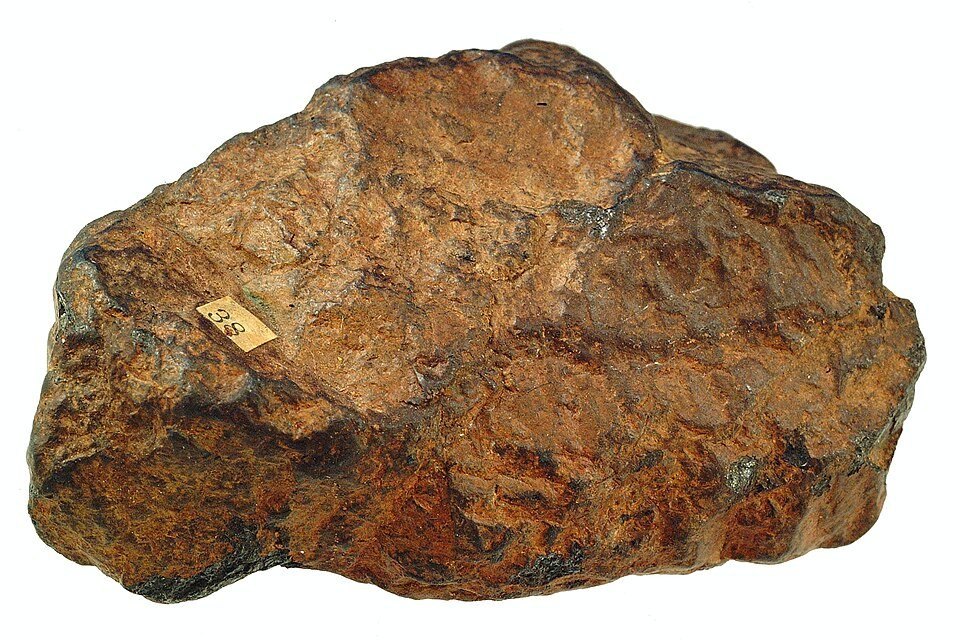
Magnetite, hematite and other iron ore concentrates, differentiated by ore grade, mining conditions and beneficiation routes.

Refractory materials

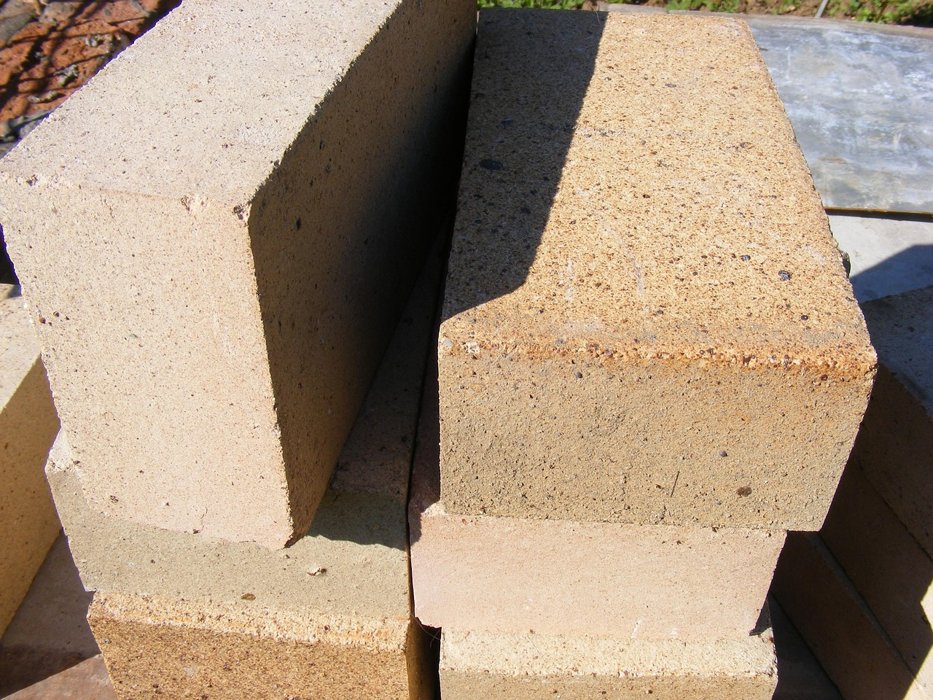
Refractory bricks, castables, gunning mixes, ramming mixes, nozzles and stopper rods for steelmaking and casting.

Metallurgical auxiliaries and alloys

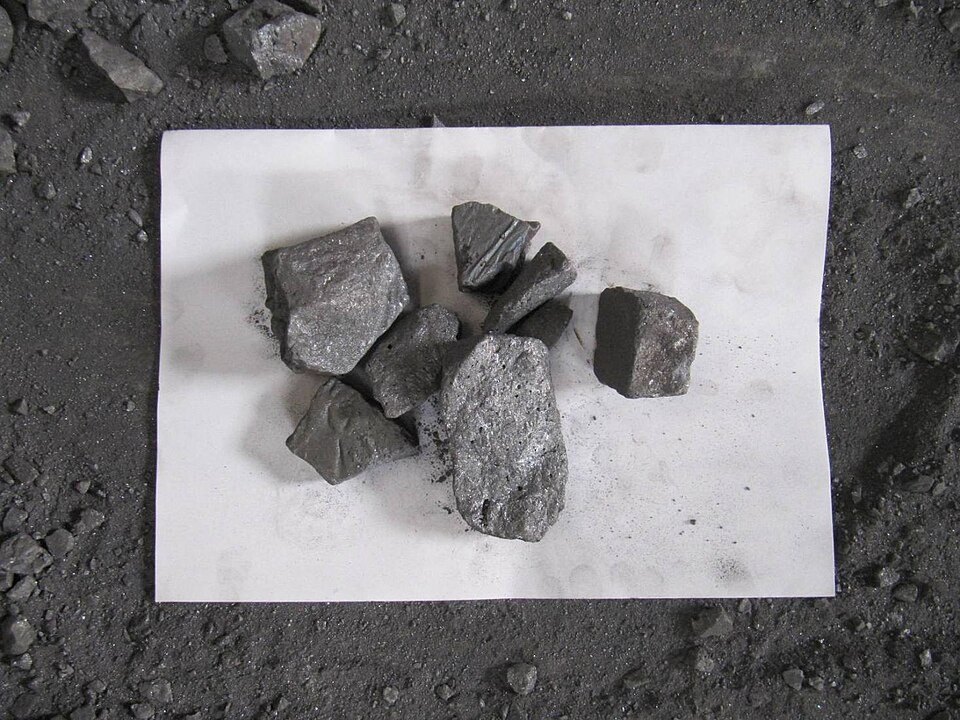
Graphite electrodes, carbon raisers, deoxidizers, refining agents, slag fluxes and comprehensive ferroalloy materials.

Billets and steel products

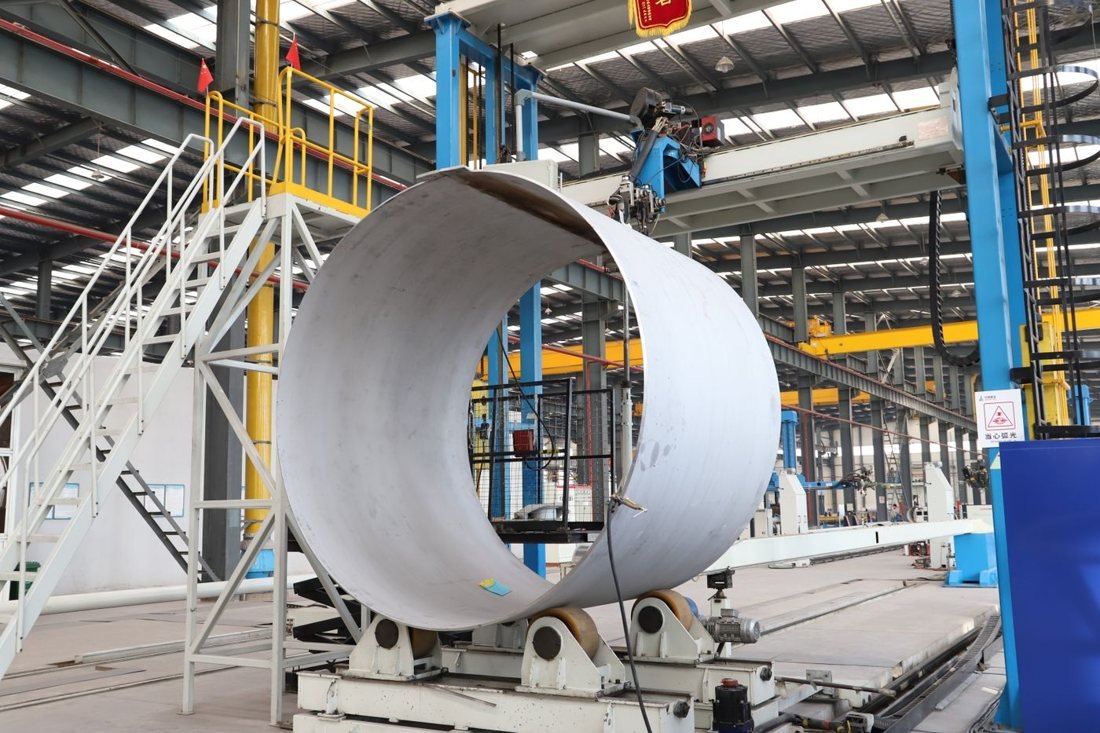
Carbon, bearing and stainless steel grades, spanning intermediate billets, hot/cold-rolled coils, heavy plates and structural pipes.

Processing and steelworks utilities

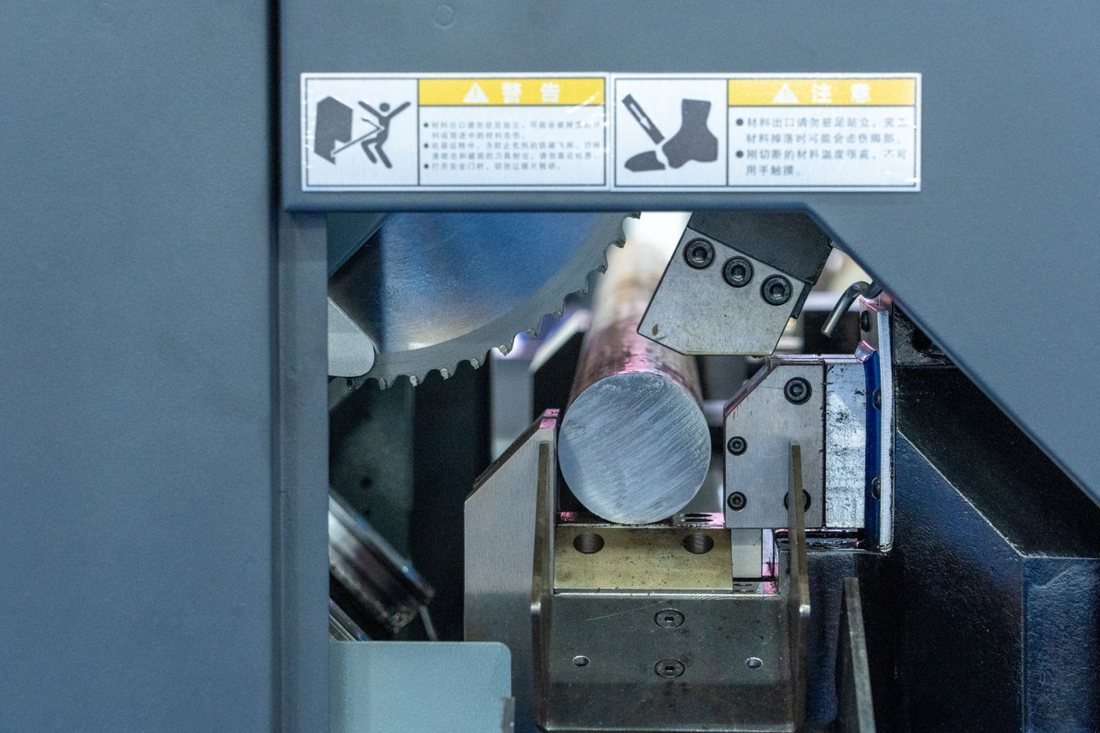
Rolling, cutting, machining, heat treatment and galvanizing, alongside industrial water supply and essential technical gases.
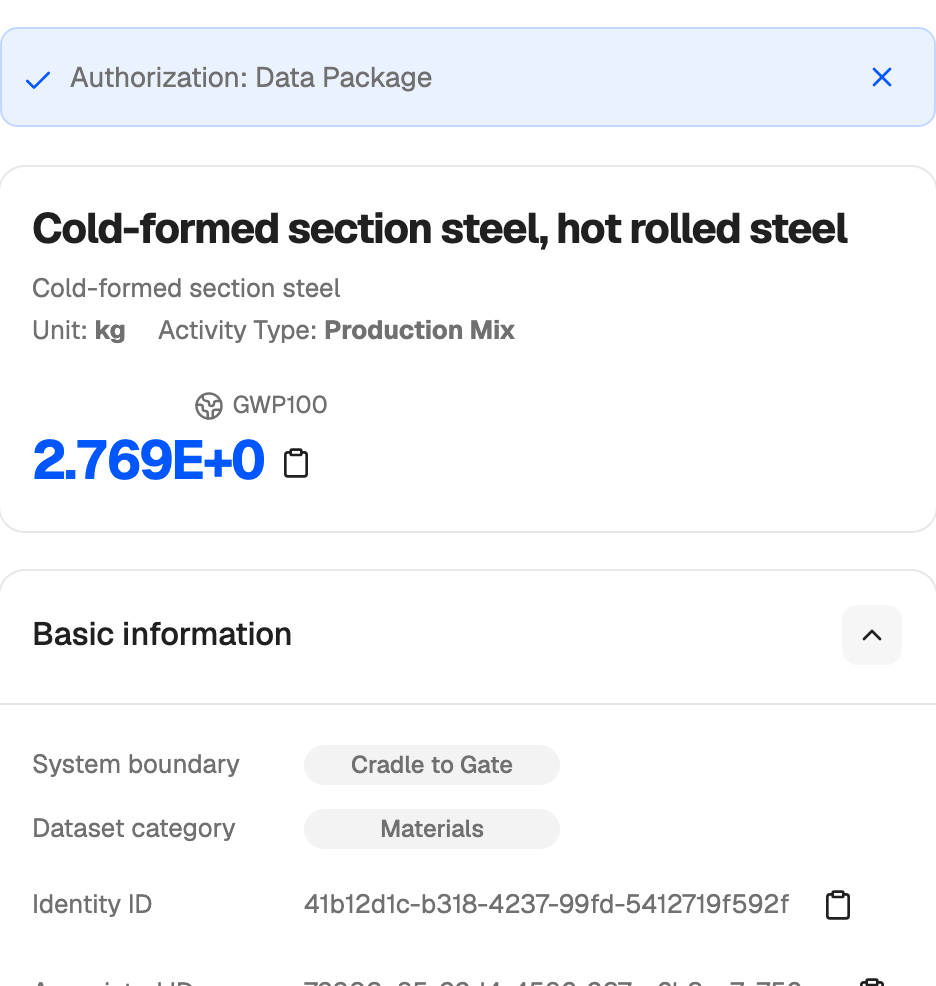
Match steel data to materials & production routes

1
Ore grades & mining processes
Cold-formed steel dataset details, view 1
Ore grades & mining processes

Select ore and concentrate records by material type, iron grade, mining method and beneficiation process.
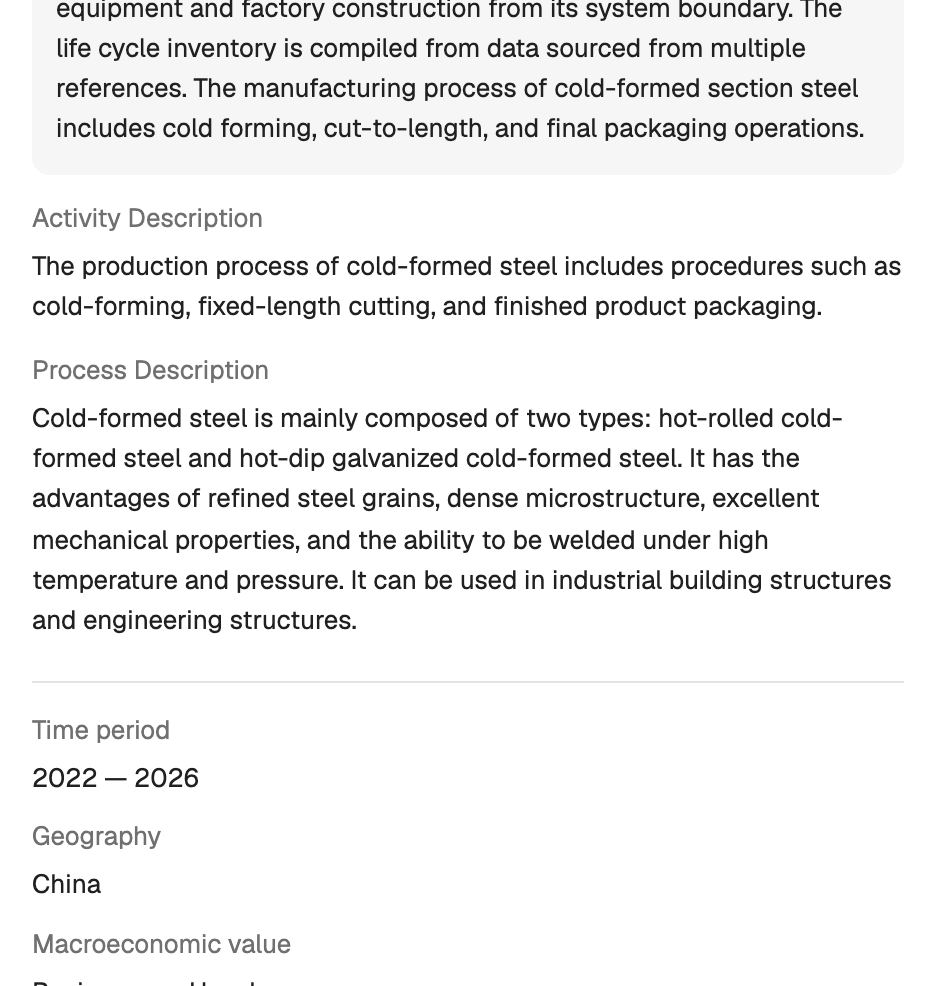
2
Steelmaking & finishing routes
Cold-formed steel dataset details, view 2
Steelmaking & finishing routes

Check steel grade, furnace route, rolling and annealing together. Available combinations vary by dataset and system model.
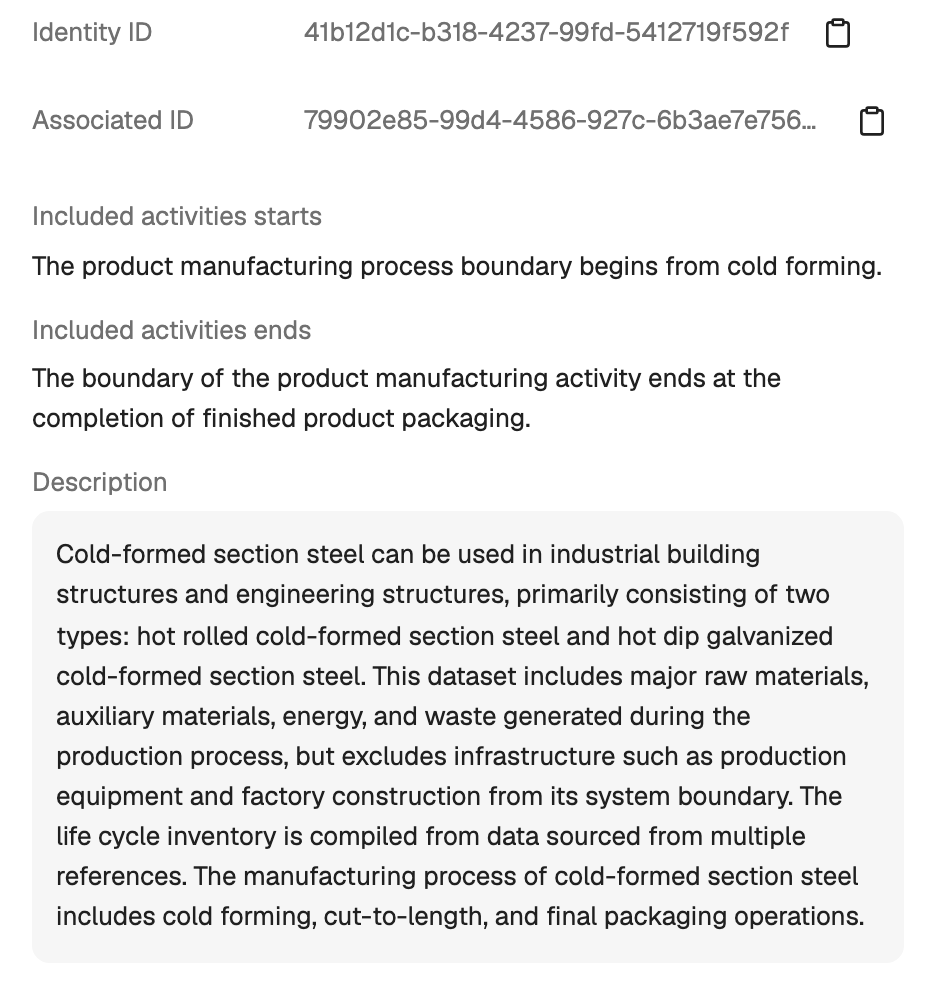
3
Refractory & auxiliary compositions
Cold-formed steel dataset details, view 3
Refractory & auxiliary compositions

Use known refractory compositions and auxiliary formulations to select specific records rather than generic material averages.
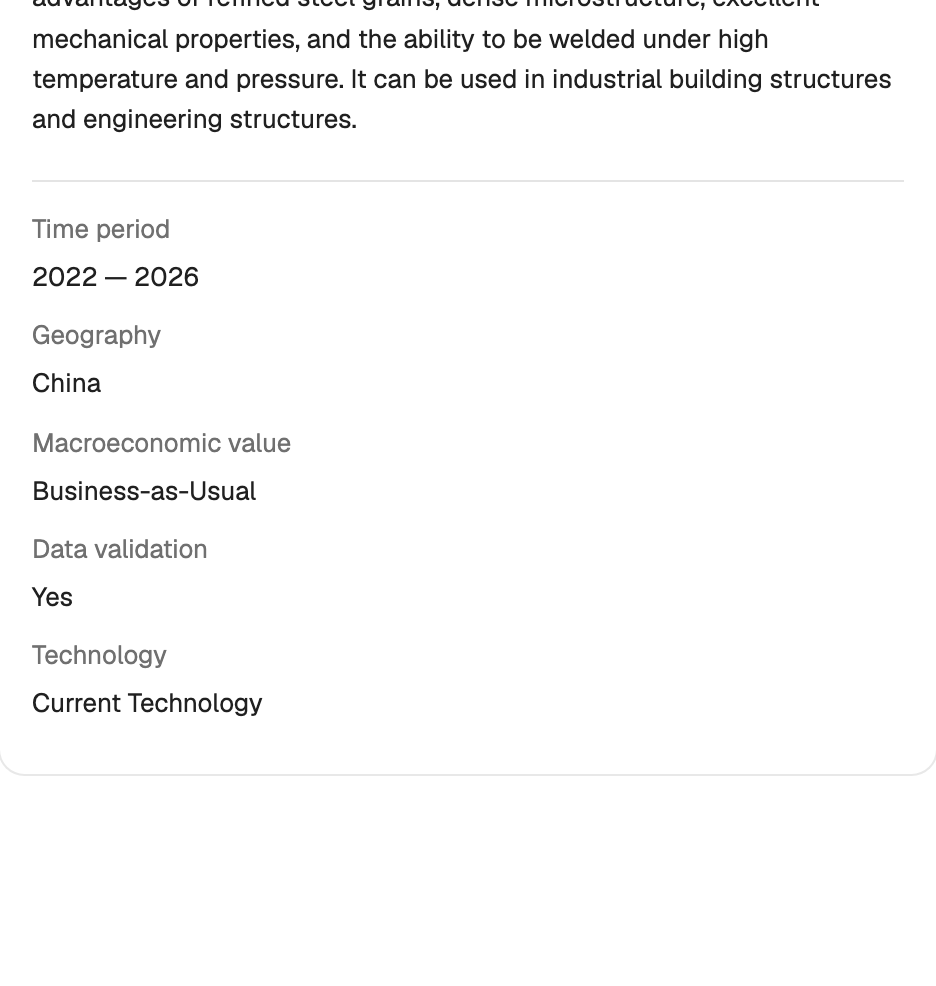
4
Geography & activity types
Cold-formed steel dataset details, view 4
Geography & activity types

Match available geography and production or consumption activities to the steel source and supply context being modelled.

Explore a sample dataset

Preview the dataset’s coverage, inputs and outputs, and environmental impact results.

Cold rolled coil, Q235B, technology mix

Cold rolled coil, Q235B

Unit: kg
Activity Type: Production Mix
GWP100
2.467e+0
System boundary
Cradle to Gate
Dataset category
Materials
Identity ID
7eca1c30-c894-46c3-986a-2f68dbaa31a3
Associated ID
0016f2b7-c721-423d-b569-25e1d05eddef
Included activities starts
This activity starts from raw material acquisition.
Included activities ends
This activity ends with the production of hot-rolled coil products and does not include product transportation and use.
Description

The varying carbon content allows cold-rolled hard steel coils to have different grades and properties, making them suitable for diverse industrial applications. The production process of cold-rolled hard coils includes pickling and cold rolling of hot rolled coils, covering energy consumption, material usage, waste management, and environmental emissions during production. This dataset has been inferred from multiple data sources.

Activity Description
The production process of cold-rolled hard coils includes pickling and cold rolling of hot-rolled coils, covering energy consumption, material consumption, waste treatment, and environmental emissions required during the production process.
Process Description
Cold-reduced hard coil is a type of steel coil that has undergone cold rolling. It belongs to the same category as cold-rolled coils, cold-rolled sheets, and cold-rolled strip steel. It is produced through cold rolling of hot-rolled steel coils after pickling to remove oxide scale. Carbon steel, also known as plain carbon steel, has a carbon content ranging from approximately 0.02% to 2%. The primary components of carbon steel cold-reduced hard coil are iron and carbon, where the carbon content determines the hardness and strength of the steel. Variations in carbon content enable different grades and properties of carbon steel cold-reduced hard coils, allowing them to meet diverse industrial requirements.

Environmental Assessments for Steel and Downstream Products

A

Steel-product assessments

Connect ores, refractories, auxiliaries, utility inputs and processing to your own plant activity data and production model.
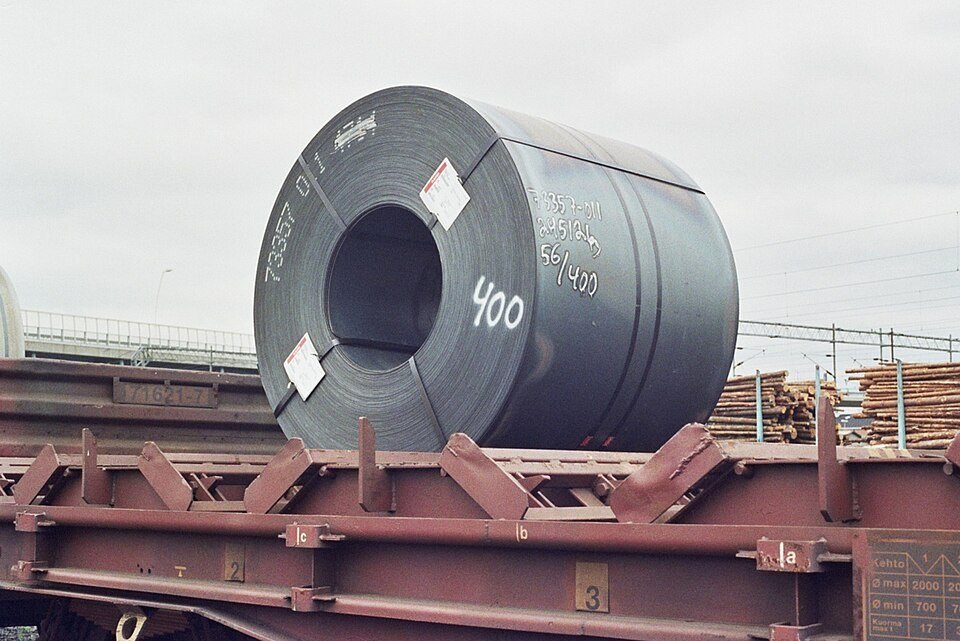
Steel coils in a railway yard in Finland; illustrative product transport
B

Downstream manufacturing

Match purchased steel by grade, form and production context for equipment, building components and other metal products.
Gray steel roofing sheet; illustrative downstream product
C

Material & process scenarios

Compare steel production routes, including BF–BOF and EAF, to support LCA and scenario analysis.
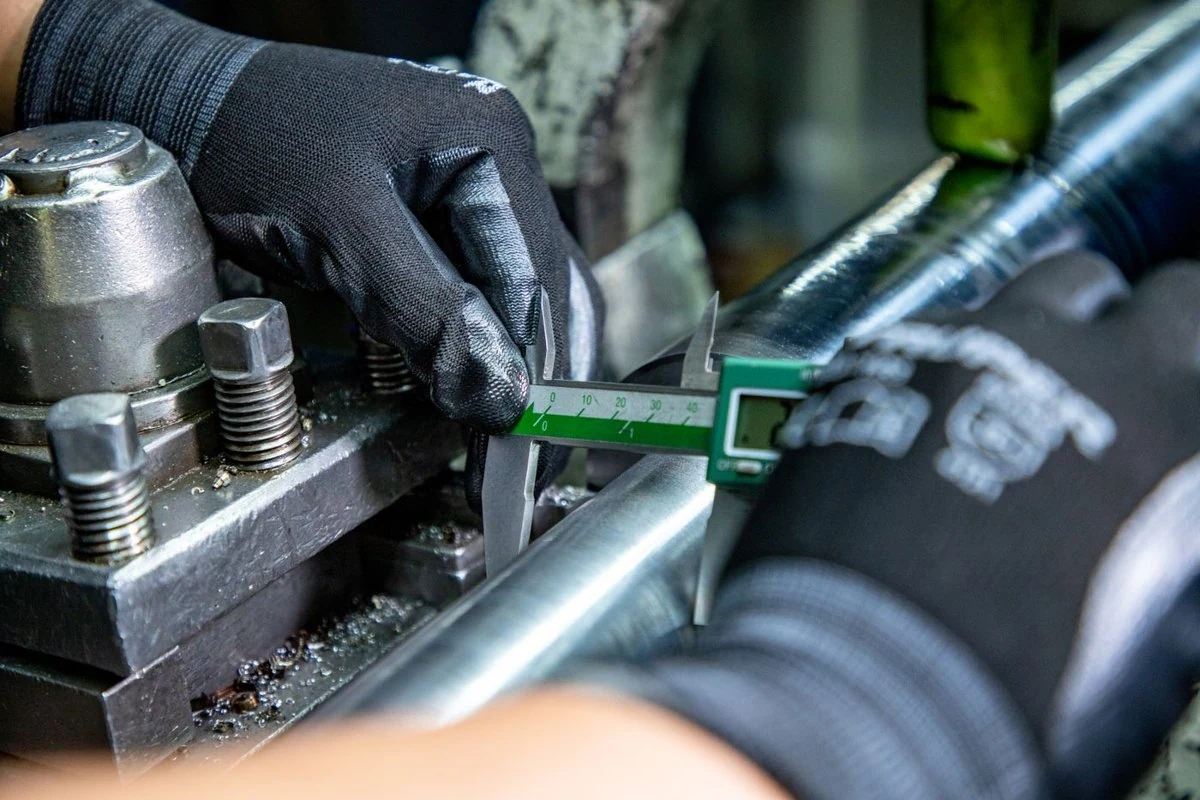
Gloved hands checking a machined metal component with a caliper; illustrative specification check
LATEST

Steel & Iron v1.5.0

Current Steel & Iron records across three system models.

5,363
Cut-off records in the Steel & Iron Database, v1.5.0.
5,111
EN 15804
Current Steel & Iron records.
5,052
Consequential
Current Steel & Iron records.
Selected steel grades and product forms
Q235B, 304 and 430; billets, plates, coils and selected pipes.
Steelmaking and processing
BOF and EAF routes for selected billets; rolling, heat treatment and galvanising.

Three ways to get the data

Search online, get a data package or connect your platform. Confirm the scope and licence for your intended use.
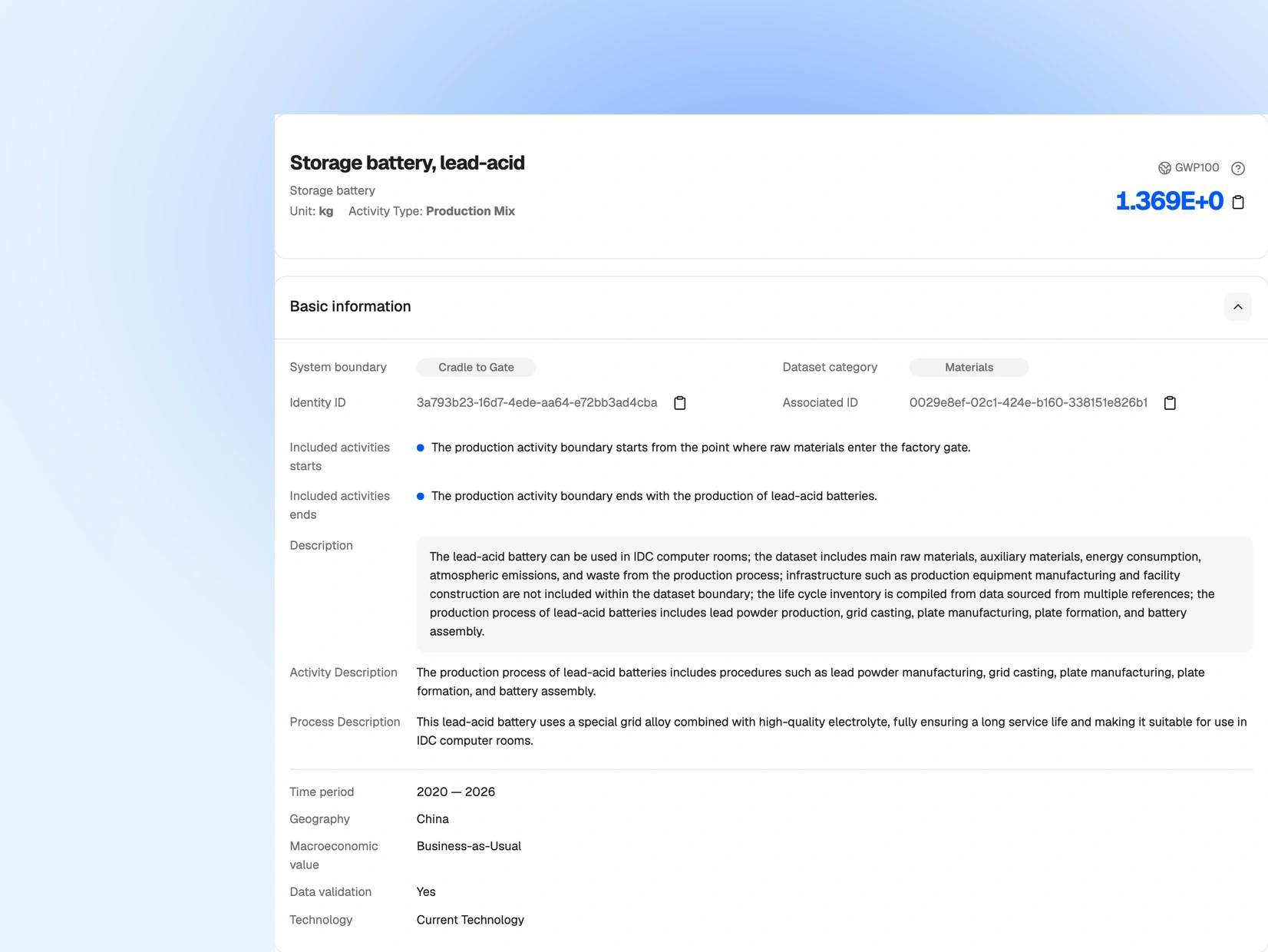
HiQLCD Square dataset view
Online access

Search and view Steel & Iron Database datasets in HIQ QUERY.
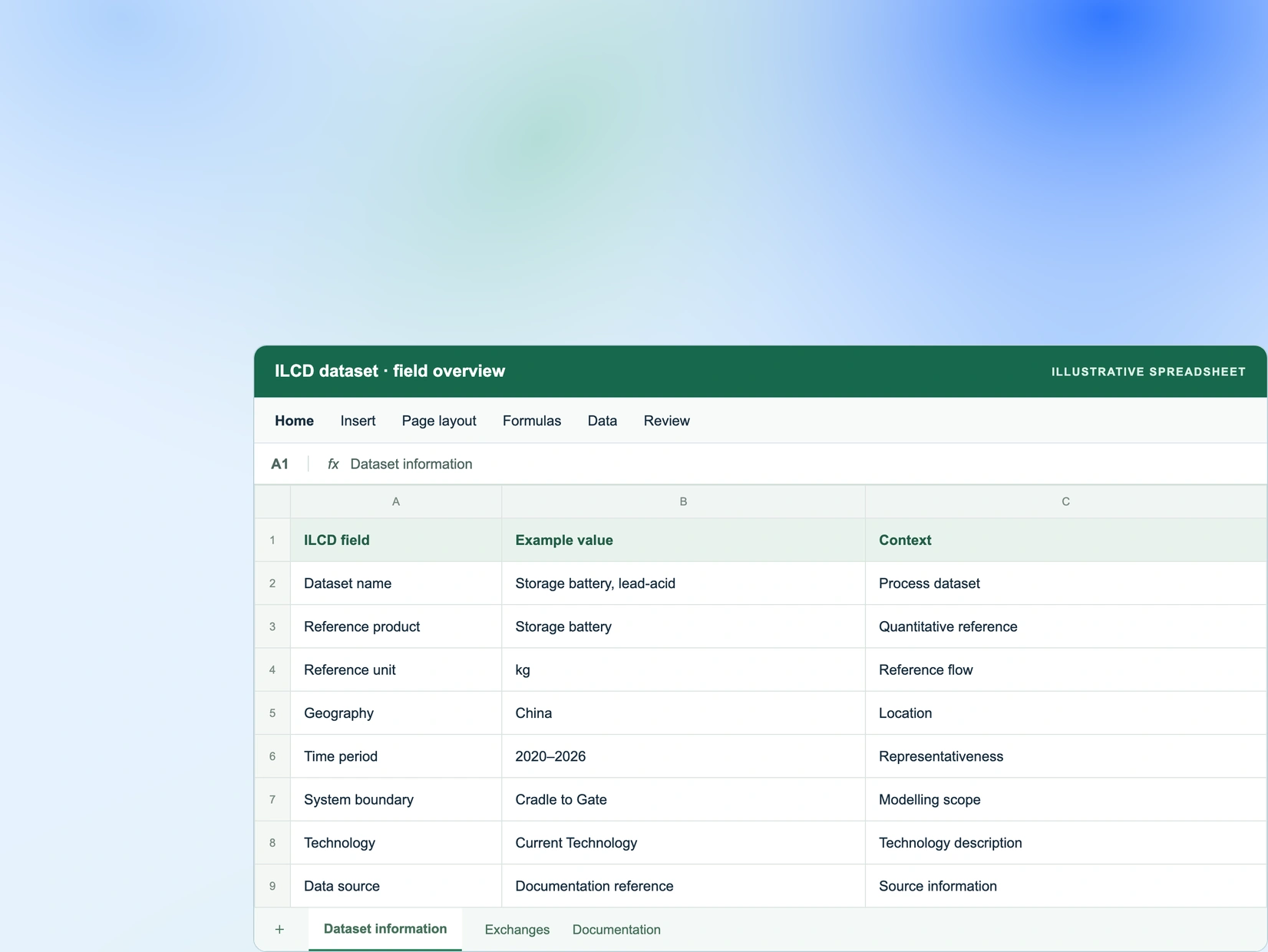
Illustrative data package fields
Data packages

Obtain HiQLCD data in ILCD or CSV formats, including EF-compliant ILCD. Confirm files available for your selected product and version.
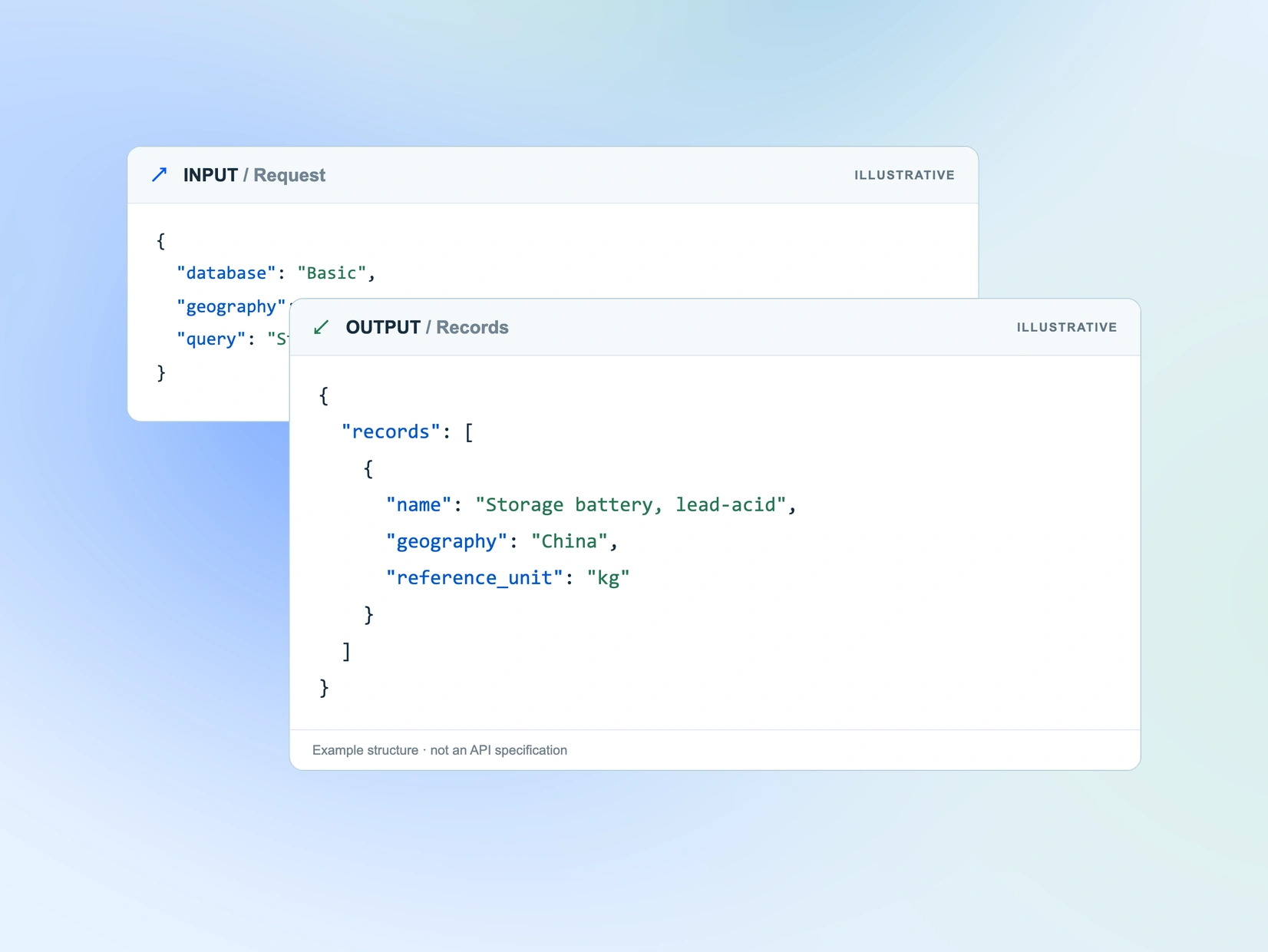
Illustrative API access windows
API access

Retrieve dataset records and available GWP results through the API. Confirm available content and permissions for this database.
Use the data in your workflow

openLCA, SimaPro, Sphera and Brightway logos
01

Your existing LCA software

Use HiQLCD data packages in openLCA, SimaPro or GaBi, with the appropriate format for your software.
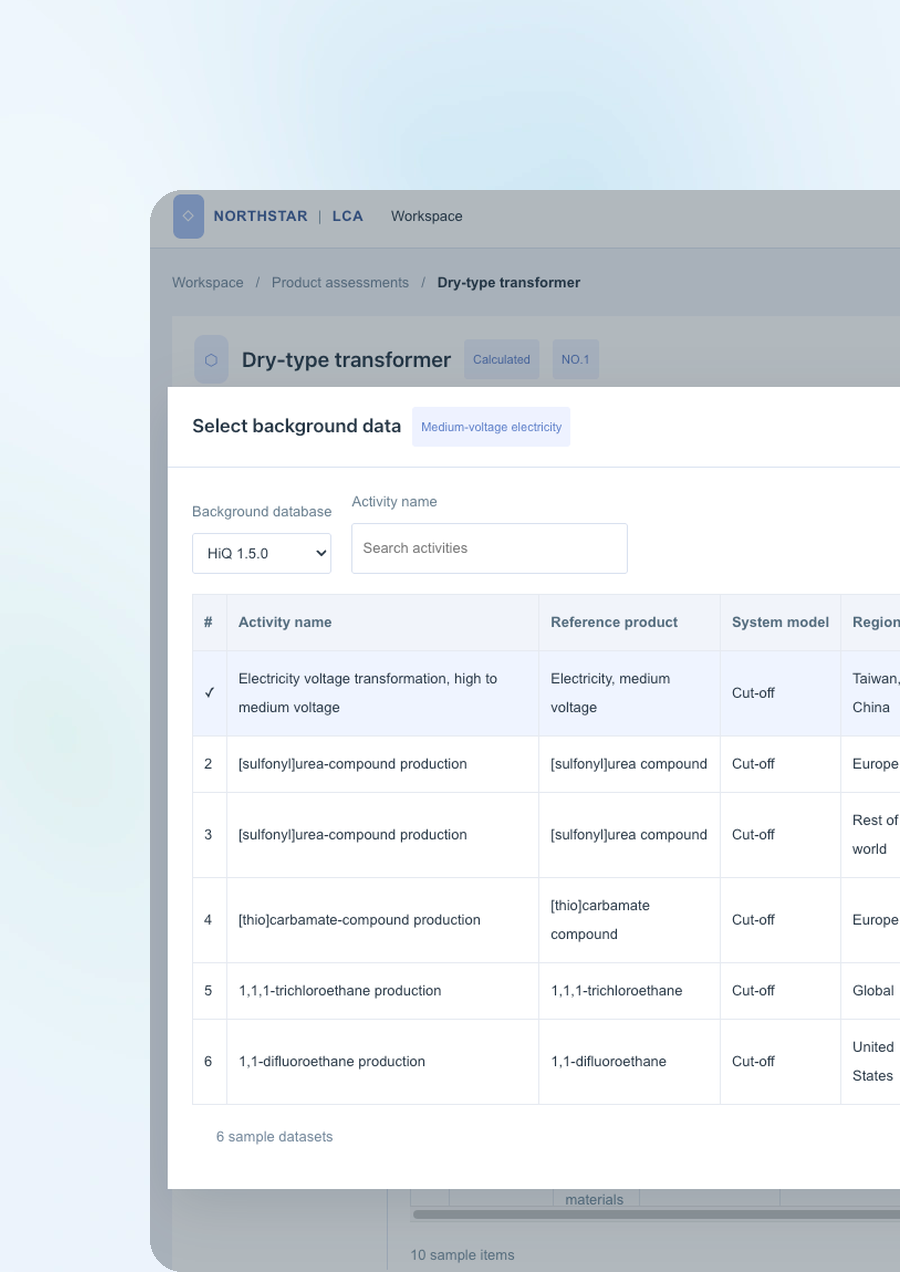
Illustrative background data selection in an LCA workspace
02

Your own platform

Integrate delivered data files, or connect search, matching and data-retrieval APIs to your application.
Page not included in this preview