
LCA-TextNet: exploring cross-sector impact prediction through unified textual descriptions
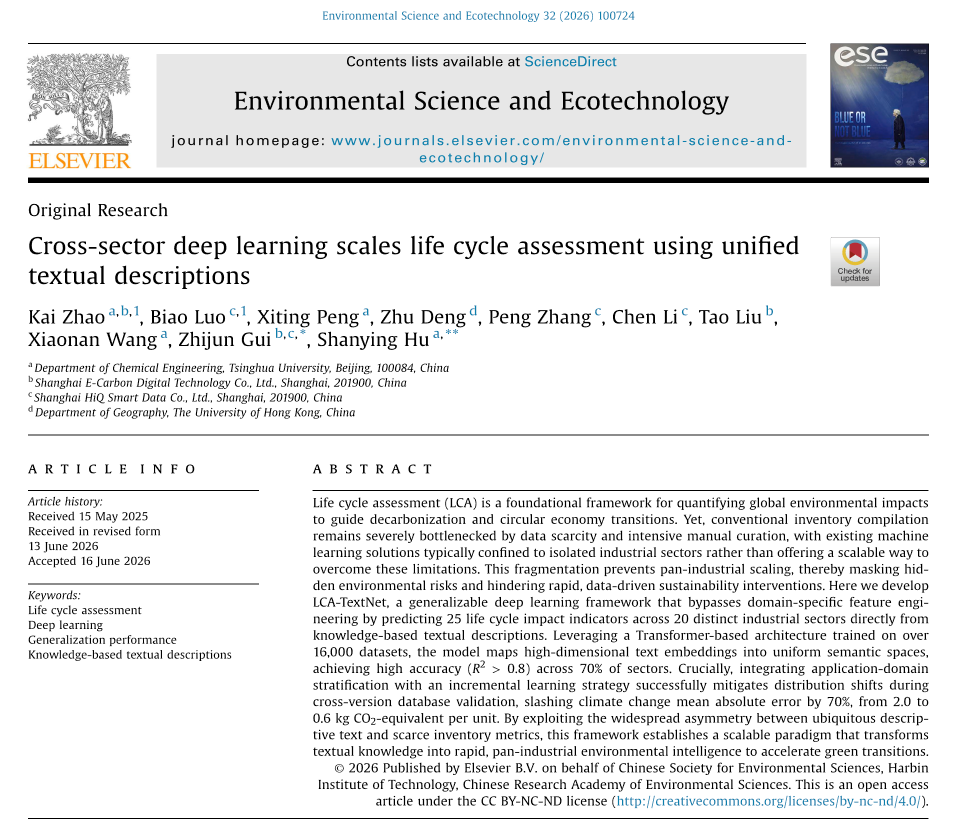
When a complete lifecycle inventory is unavailable, can product and process descriptions help with initial environmental screening? LCA-TextNet, a study coauthored by HiQ researchers, transforms textual information about different activities into a unified input to explore cross-sector prediction of life cycle impact assessment (LCIA) results and test its applicability to new data.
Research at a glance: performance and applicability together
This article presents research coauthored by HiQ. The study uses ecoinvent data and is not a HiQLCD database application case. Lower MAE means lower prediction error, not an achieved emissions reduction.
Can activities across different sectors share one input representation?
Conventional LCA relies on inventories of materials, energy, emissions and process connections. Early in a study, these inventories may be incomplete even when activity names, product descriptions, technology notes and boundary descriptions are available. LCA-TextNet investigates how such existing text can support initial estimates of environmental impacts.
The study uses a unified textual representation to reduce the need for separate feature engineering in each sector. It predicts LCIA indicator results directly. It does not thereby produce a verified, complete LCI or replace expert judgment about processes, quantities and system boundaries.
How does information enter the model?
Training data come from ecoinvent 3.10. For each activity, the study selects seven descriptive fields: activity name, reference product, CPC classification, general comment, product information, technology comment and system boundary. Prediction targets are 25 EF 3.1 LCIA results under the cut-off system model.
These steps define the scope of the results: the study does not cover every reference unit or every impact-value range. The figure of 16,154 describes the filtered sample pool, not the number used exclusively for training. Different reference units cannot all be interpreted as “per kilogram of product.”
| Step | Treatment in the study |
|---|---|
| Record selection | Retain kg, kWh or MJ reference units, yielding 18,148 records |
| Further filtering | Filter by the climate-change result range, leaving 16,154 records before the training/test split |
| Text modeling | Combine text representations, a system-boundary classifier and a neural network |
| External evaluation | Validate on ecoinvent 3.12 and separately evaluate newly introduced records |
What the study finds: performance varies by sector and indicator
The paper reports that the median R² exceeds 0.8 in 70% of sectors. However, land-use prediction performs poorly, and results are more dispersed in sectors such as transport and water supply. Unified text shows cross-sector predictive potential, but reliable and unreliable sector–indicator combinations need to be distinguished; aggregate performance is not a guarantee for each prediction.
Newly introduced records in the later database version present a larger distribution shift. Using a fixed, unseen test set, the study compares incremental-learning configurations. With the full adaptation pool, climate-change mean absolute error (MAE) falls from 2.0 to 0.6 kg CO₂ eq per reference unit, a reduction of approximately 70%. This improvement depends on the experiment’s filtering, adaptation samples and training setup; it is not an error level guaranteed for any new product.
The two 70% figures have different meanings: one describes sector performance, the other an MAE reduction in a specific experiment. Neither is a real-world emissions-reduction rate. Source: paper p. 7.
| New-data experiment | Climate-change MAE |
|---|---|
| Baseline model | 2.0 kg CO₂ eq / reference unit |
| After incremental learning with the full adaptation pool | 0.6 kg CO₂ eq / reference unit |
| Meaning | Mean absolute difference between predictions and reference LCIA results |
What is HiQ’s role in the research?
The paper brings together authors affiliated with Tsinghua University, Shanghai HiQ Smart Data Co., Ltd., the University of Hong Kong and ECarbon. Affiliations and contribution statements identify participation by HiQ researchers in conceptualization, methodology, data curation, validation and resource support. This establishes collaborative research participation, not an external customer’s purchase or use of HiQLCD.
The work explores how textual information can support initial LCIA prediction and how to identify cases that require detailed data and expert review. The database provides the basis for training and evaluation; in the published study, that source is ecoinvent.
From rapid screening to informed research use
For research and teaching, LCA-TextNet offers a workflow to examine: define the activity and boundary, assess whether the input falls within the model’s applicability domain, inspect performance for the relevant sector and indicator, and decide where screening is appropriate or further inventory work and expert review are needed. Poorly predicted indicators such as land use require particular care.
The model is evaluated against database-calculated results, rather than independent measurements of every real-world activity. Reproduction or extension requires attention to database licensing, sample filtering, separation of training and testing, version differences and interpretation. Publicly available code does not automatically confer access to, or redistribution rights for, the underlying data.
Explore the paper and methods to plan your next study
Start with the paper’s methods, supplementary experiments and applicability limits to decide whether text-based prediction fits your research question. If a project also requires background data for Chinese production, relevant HiQLCD records and versions can be examined separately. That is a data-selection task for the new project, not the source of this paper’s training data.