
Minfa aluminium profiles: connecting manufacturer information to upstream data
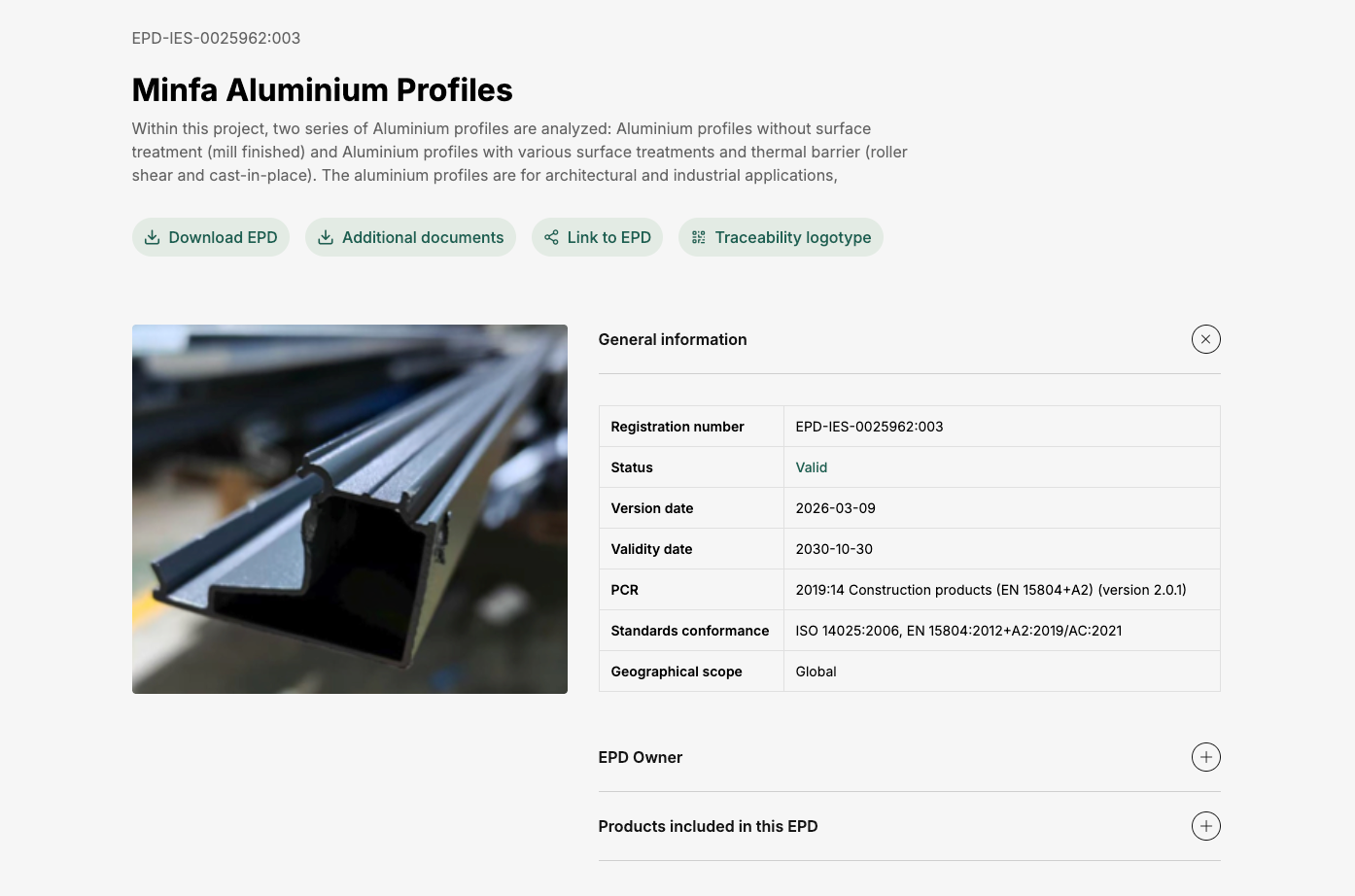
Minfa’s published EPD combines manufacturer information with ecoinvent and HiQLCD background data to assess aluminium profiles across production, transport and end-of-life scenarios. HiQLCD is used mainly for upstream electrolytic aluminium production.
An aluminium declaration: the key facts
7.85 is the EPD’s reported A1–A3 result, to be used with C1–C4 and the declared scenarios; it is not a result attributable to HiQLCD alone.
From manufactured profiles to the declared product system
Fujian Minfa Aluminium’s declaration covers profiles for architectural and industrial applications, including mill-finished products and series with surface treatments and thermal barriers. Manufacturing includes melting, casting, extrusion, cutting and surface treatment, with thermal-barrier assembly where applicable.
The assessment uses a declared unit of 1 kg of aluminium profile, including the applicable surface treatment, thermal-barrier materials and packaging described in the EPD. It covers A1–A3, A4, C1–C4 and D; installation A5 and use-stage modules B1–B7 are not declared. A1–A3 represents production in China, with transport and end of life modeled under the declaration’s scenarios.
Factory inventories and upstream backgrounds complete different parts of the model
The manufacturer supplied material, energy, emissions and waste information from its July 2024–June 2025 production inventory. These data describe profile manufacturing, while the upstream production of purchased aluminium still requires background records.
The EPD lists ecoinvent 3.11 for purchased aluminium billets and ecoinvent 3.11 with HiQLCD for primary aluminium ingot production. Its methods further identify upstream electrolytic aluminium production as HiQLCD’s main application. HiQLCD supplies part of the material background; manufacturer inventories, other databases and declared scenarios together form the assessment.
| Model element | Disclosed source |
|---|---|
| Profile-production information | EPD owner’s production inventory |
| Purchased aluminium billets | ecoinvent 3.11 |
| Primary ingot and upstream electrolytic aluminium | ecoinvent 3.11 + HiQLCD; HiQLCD mainly for electrolytic aluminium |
The product stage dominates the declared climate profile
A1–A3 GWP-total is 7.85 kg CO₂-eq per kilogram of profile, larger than any other individually reported lifecycle module. This points analysis toward raw-material supply and manufacturing, followed by closer examination of metal sourcing, recycled materials, energy and process data. The public module table does not attribute all A1–A3 impacts to electrolytic aluminium or HiQLCD.
Source: EPD p. 12, GWP-total row. D is reported separately and is not deducted from A1–A3; C1–C4 should be considered when using product-stage results.
| Module | GWP-total: kg CO₂-eq / kg profile |
|---|---|
| A1–A3 · Raw materials, inbound transport and manufacturing | 7.85 |
| A4 · Product transport | 0.165 |
| C1 · Deconstruction | 0.000375 |
| C2 · Waste transport | 0.0130 |
| C3 · Waste processing | 0.00203 |
| C4 · Disposal | 0.0561 |
| D · Beyond-boundary recovery-related result | −0.863 |
Recovery assumptions determine how the numbers can be used
The baseline end-of-life scenario assumes 75% recycling and 25% landfill, with additional scenarios for 100% recycling and 100% landfill. Module D depends on net recovered-material flows and secondary-production burdens. Its negative value cannot be read directly as an achieved factory emissions reduction per kilogram of profile.
For another aluminium product, the transferable approach is to combine manufacturer information, matched upstream backgrounds and explicit lifecycle scenarios. Before transferring values, revisit alloy and product specification, surface treatment, recycled and primary metal sourcing, production energy, allocation and recovery assumptions.
Understand the scope of the public evidence
The EPD establishes that HiQLCD was used in its background-data layer, but does not disclose a HiQLCD version, record-by-record inventory or a comparison after database substitution. This case therefore does not quantify HiQLCD’s independent contribution to the total or infer a purchasing or commercial relationship with Minfa.
The EPD owner is Fujian Minfa Aluminium Inc., and the named LCA practitioner is Star Talers EnviroTech Ltd. HiQLCD is a background-data source within that work; authorship and verification responsibilities remain those identified in the original declaration.
Inspect upstream data for your aluminium product
Start with the product specification and production route. List the primary aluminium, secondary aluminium, billet, energy and other processes needed, then inspect current records for their units, technology and boundaries. Share your inventory and EPD project requirements to discuss suitable data, versions and formats.