
EN 15804 Inventory Indicators and Biogenic Carbon
What Is Counted and How
The EN15804 model includes indicators describing resource use, waste categories, output flows, and biogenic carbon content. Some are calculated using specific elementary flows through a characterization-like method; others are derived from physical flow properties. The distinction depends on whether the indicator describes the process, such as secondary material use, or the product, such as biogenic carbon content.
The indicator names and abbreviations are set out below. Read or exchange each indicator with the unit and reference flow attached to the reported result.
Technical Reference: Resource Use
| Abbreviation | Indicator and quantity described |
|---|---|
| SM | Use of secondary material. |
| RSF | Renewable secondary fuels. |
| NRSF | Non-renewable secondary fuels. |
| PERM | Use of renewable primary energy resources used as raw materials. |
| PENRM | Use of non-renewable primary energy resources used as raw materials. |
| PERE | Use of renewable primary energy excluding renewable primary energy resources used as raw materials. |
| PENRE | Use of non-renewable primary energy excluding non-renewable primary energy resources used as raw materials. |
| PERT | Total use of renewable primary energy resources. |
| PENRT | Total use of non-renewable primary energy resources. |
| FW | Net use of fresh water. |
Technical Reference: Waste Disposed
| Abbreviation | Indicator and quantity described |
|---|---|
| HWD | Hazardous waste disposed. |
| NHWD | Non-hazardous waste disposed. |
| ILLRW | Intermediate and low-level radioactive waste disposed. |
| HLRW | High-level radioactive waste disposed. |
Technical Reference: Output Flows
| Abbreviation | Indicator and quantity described |
|---|---|
| MFR | Materials for recycling. |
| MER | Materials for energy recovery. |
| EEE | Exported energy-electricity. |
| EET | Exported energy-heat. |
Materials for recycling, materials for energy recovery and exported energy are calculated on the amounts “leaving the system boundary when they have reached their end-of-waste state”.
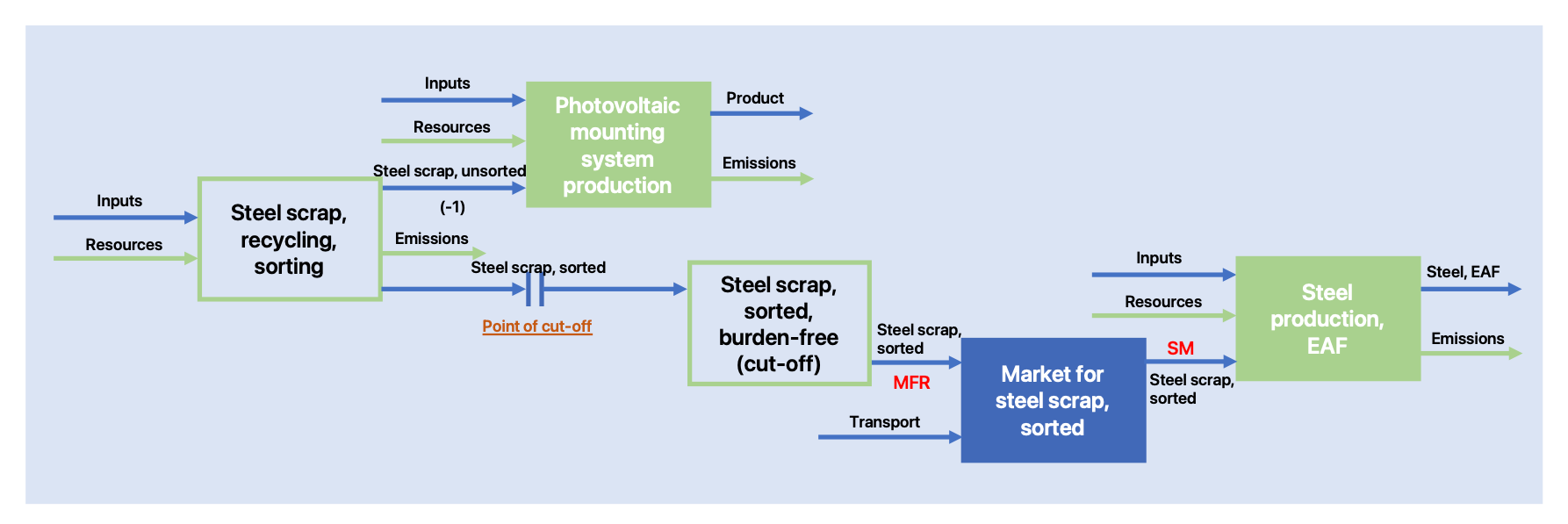
In the steel-scrap illustration, sorted scrap leaving the primary system after the end-of-waste cut-off is counted as materials for recycling (MFR). The path includes transport and a sorted-scrap market. Use of secondary material (SM) is measured where the scrap enters steel production in the receiving system. Neither indicator is measured at the initial collection of unsorted scrap.
Technical Reference: Biogenic Carbon Content
| Abbreviation | Indicator | Calculation basis |
|---|---|---|
| BCCP | Biogenic carbon content in product | The "Carbon content, non-fossil" property of the product flow. |
| BCCAP | Biogenic carbon content in accompanying packaging | The "Carbon content, non-fossil" properties of the relevant packaging material inputs and outputs, combined with mass balance calculations. |
Biogenic carbon content is calculated from flow properties rather than an independent inventory flow. It describes carbon contained in the product or packaging and is interpreted separately from the climate-change impact result.