
Reference Flows, Activities, and Boundaries
Functional Unit and Reference Flow
A functional unit expresses the quantified performance used as the reference for a study. It depends on the function and application context. A dataset's reference flow expresses the quantity of product or service modelled; its physical properties support conversion to the study's functional requirement.
The general principle applied in HiQLCD is that reference flows of products should reflect ‘physical’ flows as accurately as possible, while specific product properties are listed separately in the process and/or comment fields. For example, the main reference flow for fuel coal is defined as 1 kg, while the carbon content and low calorific value are given as additional properties.
Unit conversion uses the appropriate conversion factor within the same unit group, such as mass units. Converting between different physical quantities requires the relevant product properties; the use of a 1 kg reference flow does not make two products functionally equivalent.
Elementary and Intermediate Exchanges
| Exchange | Connection and examples |
|---|---|
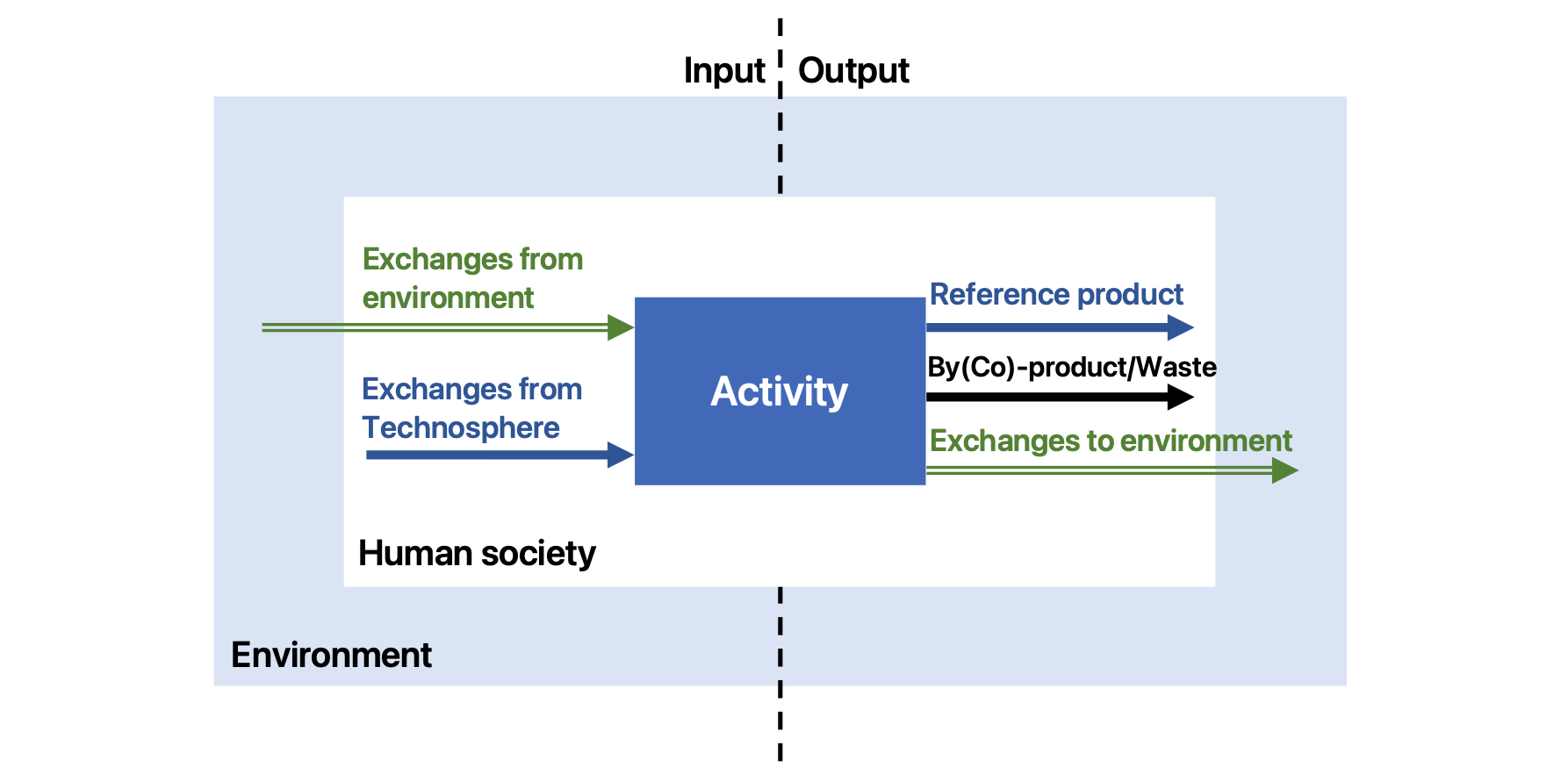
| Elementary exchange | Directly connects an activity with the environment. Inputs include resource extraction, water taken from a river, and CO2 uptake by trees; outputs include emissions to air, water, or soil. |
| Intermediate exchange | Connects processes within the technosphere. Material and energy exchanges can include reference products, co-products, by-products, and wastes. |
Activity Types and Their Reference Flows
| Activity type | Description and modelling implications |
|---|---|
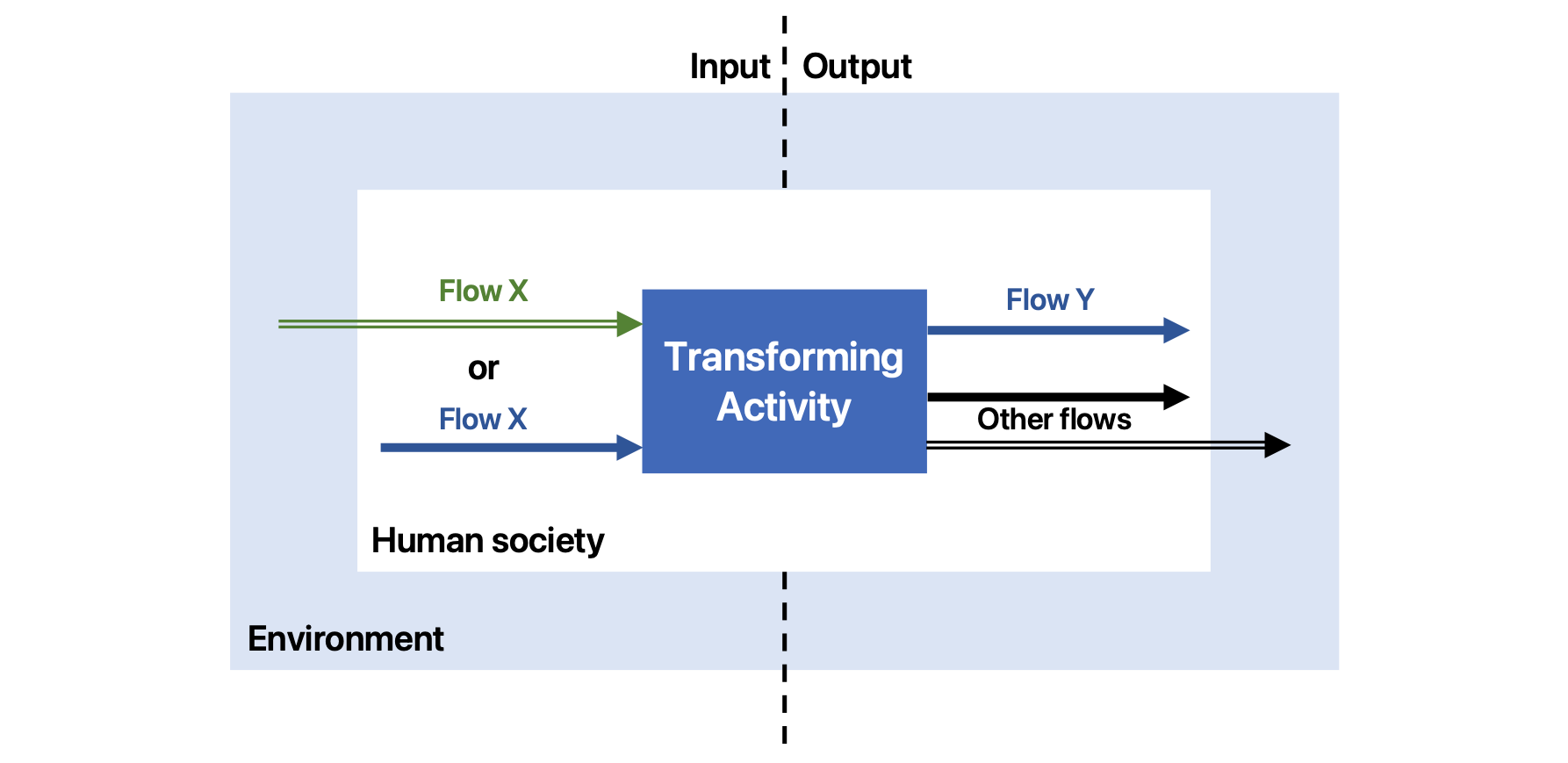
| Normal transforming activity | Transforms inputs into different outputs, such as hard coal in the ground into marketable hard coal. The methodology distinguishes material activities and energy activities by their reference outputs; energy carriers are excluded from the latter category. |
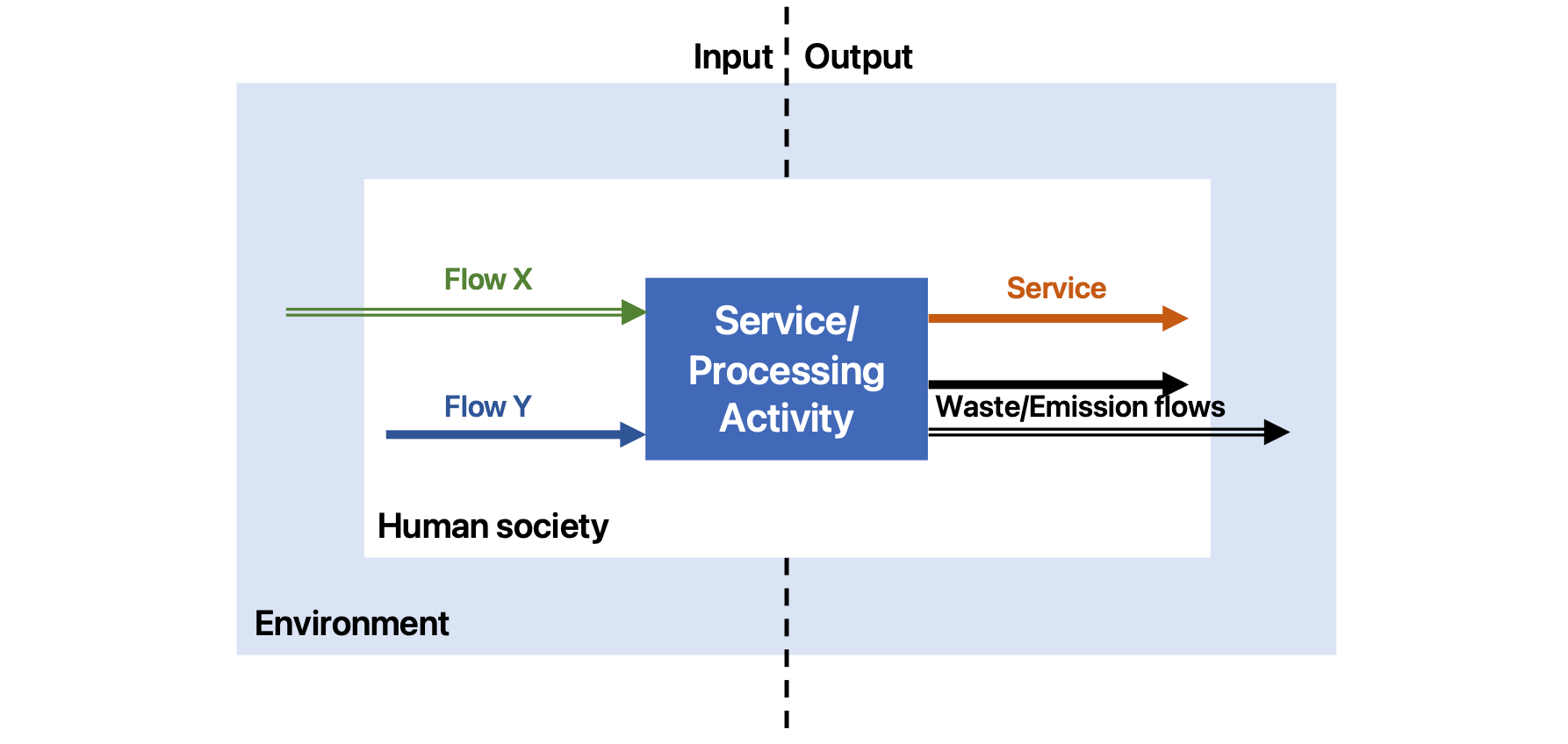
| Service or processing activity | Enables or supports another activity without directly including the serviced product's material flows. Chainsaw operation, for example, includes the equipment, fuel, and associated emissions, while the trees belong to the forestry process. |
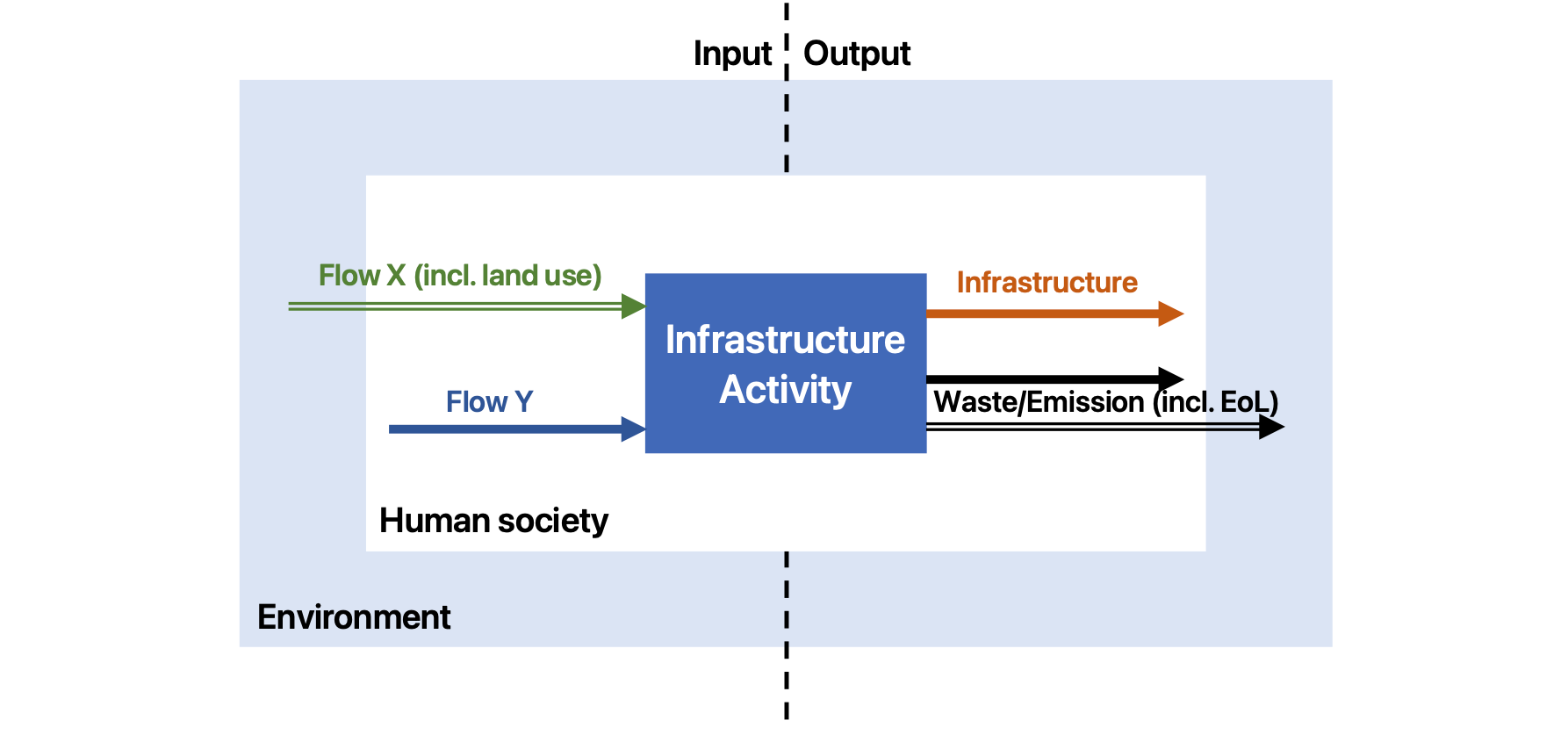
| Infrastructure activity | Creates and uses long-term capital goods, such as buildings, machinery, roads, and production facilities, generally with a service life exceeding one year. Construction, maintenance, applicable land use and transformation, and end-of-life disposal are considered. Infrastructure products are characterized by service life and capacity rather than direct mass parameters. |
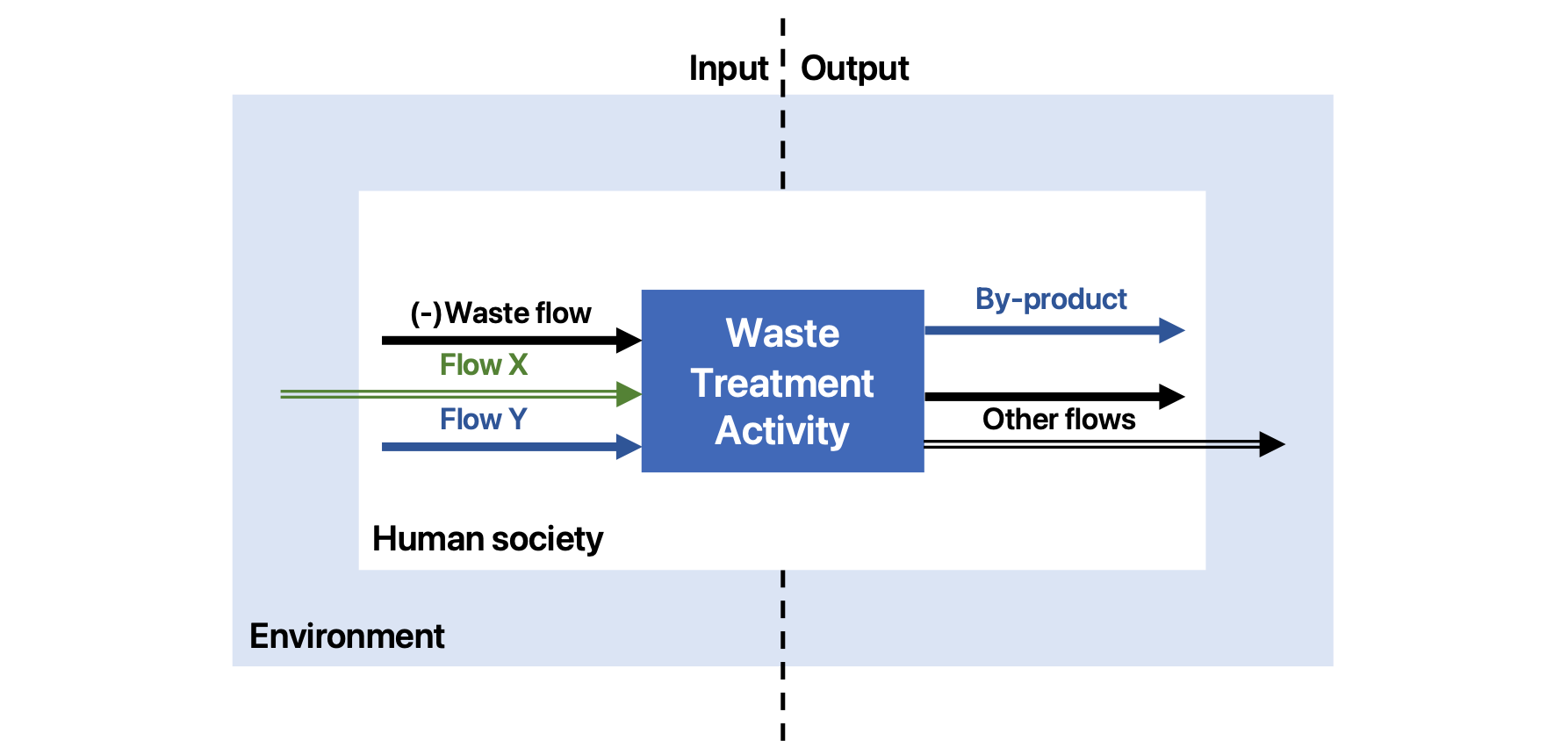
| Waste treatment activity | Manages waste by converting it into valuable products or releases to the environment. The reference flow is usually on the input side and represents the waste being treated. Recycling-oriented treatment and final disposal are distinguished. |
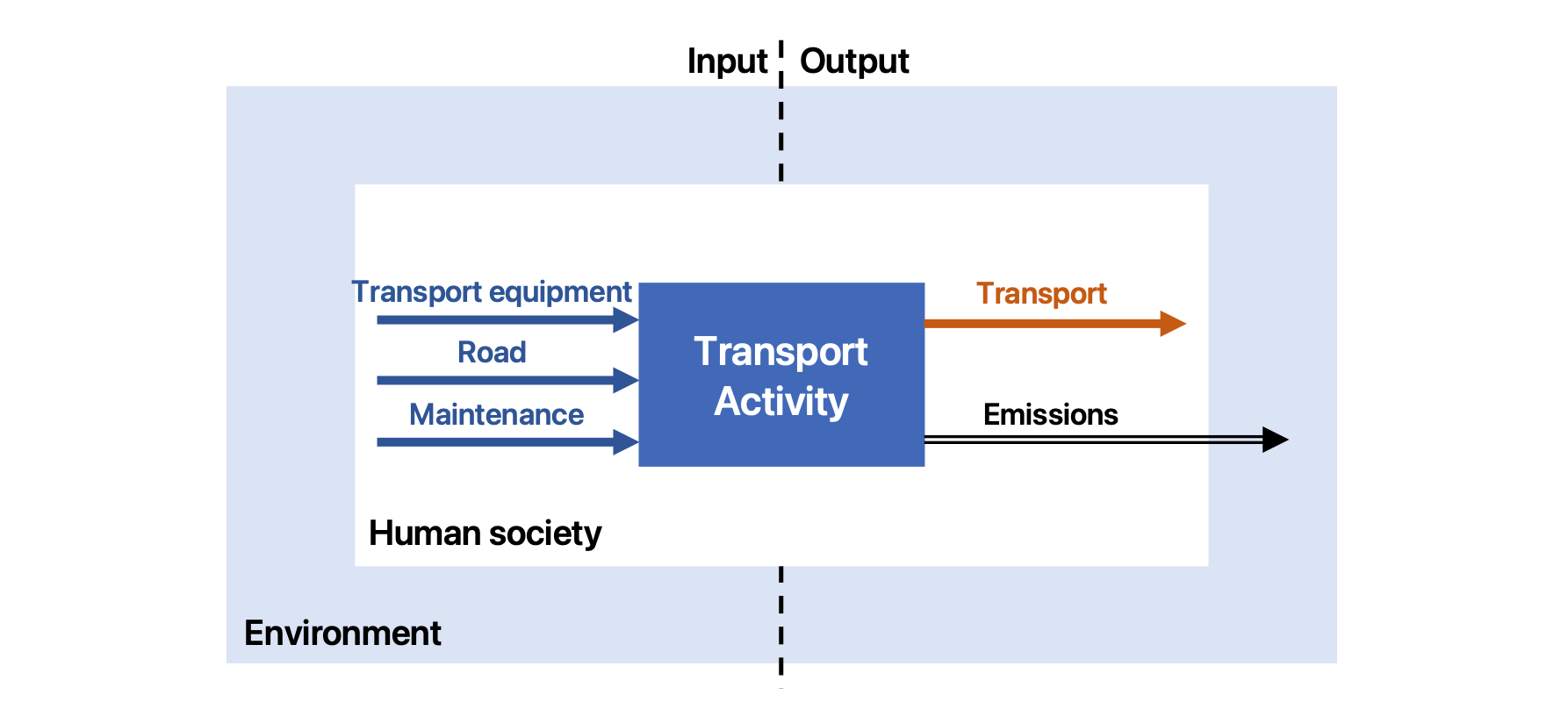
| Transport activity | Moves an object between locations over a distance. Freight modelling considers energy and emissions per unit of mass and distance, as well as road and vehicle burdens. |
A treatment reference flow, a recovered-material output, and an exported-energy output are different quantities. Match each exchange to its stated unit and direction. In treatment diagrams, a negative waste flow can represent the treatment requirement; it is not a negative environmental emission.
Boundary Types
System boundaries define the processes, material flows, and energy flows included in the product system represented by a dataset, with the scope determined by the type of dataset requested (e.g. gate-to-gate, cradle-to-gate, or cradle-to-gate + EoL).
| Boundary | Scope to check in the dataset |
|---|---|
| Gate-to-gate | The specified production, processing, or treatment activity, with upstream and downstream connections supplied at the appropriate study level. |
| Cradle-to-gate | The upstream resource and production chain through the gate of the product represented. |
| Cradle-to-gate + end of life (EoL) | The defined production chain plus the specified end-of-life stages. |
Sector-Specific Processes in the Methodology's Boundary Table
Check the sector-specific processes against the boundary of the selected dataset. When connecting electricity supply, for example, check which generating infrastructure and grid stages are already included. For coal, distinguish extraction from preparation and check where transport to the washing plant is accounted for.
| Sector or activity | Processes in the sector boundary framework |
|---|---|
| Coal: open-pit operation | Drilling, blasting, loading, crushing, transportation, dumping, pollutant treatment and disposal. |
| Coal: underground operation | Tunnelling, coal extraction, machinery and equipment, underground and in-plant transportation, ventilation, pollutant treatment and disposal. |
| Coal: preparation and beneficiation | Transportation from coal mines to washing plants, storage, crushing and screening; raw coal beneficiation; dewatering and drying. |
| Crude oil and natural gas | Onshore and offshore exploration and drilling; resource extraction; venting and flaring emissions; water use and wastewater treatment; on-site pipeline transportation. |
| Electricity | Construction, reinvestments, and decommissioning of the energy conversion plant; material and energy inputs to energy conversion; nitrogen-oxide and sulfur-oxide abatement units (DeNOx and DeSOx); maintenance; pollutant treatment and disposal; transmission and distribution losses; construction and decommissioning of distribution infrastructure. |
| Mining ores and minerals | Open-pit drilling, blasting, overburden stripping, ore loading and transportation; underground tunnelling, machinery and equipment, underground and in-plant transportation, ventilation, pollutant treatment and disposal; mining construction; ore collection and lifting. |
| Iron and steel | Mining of metal ore; self-produced fuels, electricity and thermal energy; coke and related reduction media; auxiliary-input production; steelmaking, waste treatment and disposal. |
| Renewable-energy generation equipment: photovoltaic modules and wind turbines | Component production; assembly; decommissioning and disassembly of equipment. |
| End of life | Collection and transportation; mechanical and chemical pre-treatment; recycling; sludge and slag treatment; energy-efficiency measures and energy recovery as electricity or heat; combustion calculations including relevant emissions; leachate treatment; landfill-gas processing; infrastructure such as wastewater treatment plants. |
| Transportation | Energy consumption and emissions; infrastructure such as roads and rail; facilities such as trucks and locomotives; transportation losses. |
Cut-off Rules for Omitting Flows
Here, a cut-off rule concerns the omission of less relevant life-cycle stages, activities, processes, products, or elementary flows. It is separate from the Cut-off system model used for allocation and recycling.
Relevance is determined by the flow's contribution to environmental impact results, using iterative screening or expert judgment, together with the specific requirements of applicable product category rules (PCRs). Lower-quality estimates can be used for less relevant parts so that data-collection effort can focus on important processes and flows.
As a general rule, material or energy flows may be omitted if data are lacking and the flows considered for omission together account for less than 1% of the material and energy flow and less than 5% of the environmental impact in each impact category.
The cumulative condition applies to the combined flows proposed for omission. The rule requires both the material-and-energy condition and the environmental-impact condition for each category; a small mass alone is not a sufficient reason to omit an environmentally important substance. Apply the relevant PCR together with this assessment.