Naming, Documentation, and Traceability
Process Names
Consistent nomenclature supports dataset identification and is based primarily on International Life Cycle Data System (ILCD) guidance. Process names use the following dimensions to distinguish technical activities; the complete dataset description supplies the geography, time, system model, reference flow, and boundary needed for selection.
| Naming dimension | Meaning |
|---|---|
| Product name | The specific output product or service. |
| Technological pathway / process route | Technology or process used for production or service provision. |
| Material / composition | Product materials or ingredients. |
| Shape / physical state | Solid, liquid, gas, or geometric form such as sheet, tube, or wire. |
| Quantitative specifications | Parameters such as diameter, length, or power rating. |
| Application scope | The function or use scenario, such as agricultural or industrial equipment. |
| Fuel type | Fuel used in production, power generation, equipment, or transportation. |
| Qualitative product quality | Characteristics or grade, such as high density, purity, or food grade. |
| Standard | Regulations or standards applicable to the product or service, such as CN IV or CN V for vehicles. |
| Source | Feedstock origin, such as virgin/recycled or biomass/fossil-based. |
| Supplementary annotations | Important information not covered by the other dimensions. |
In "Single-Si photovoltaic cell; TOPCon technology; N-type; 210mm*210mm", the name identifies the product, technology, cell type, and dimensions. The dimensions used in a name depend on the activity. A "source" qualifier gives the feedstock origin; look in source records for the evidence behind the data.
Flow Names and Properties
Flows are organized by technical characteristics for non-elementary flows and natural resources, and by air, water, and soil compartments for emissions. Product and waste names combine a commonly understood basic name with fields for material, composition, content, or other properties, such as "Iron ore, 45%Fe". Abbreviations are used only when widely recognized.
| Flow-documentation field | Information retained where suitable |
|---|---|
| Reference quantity | Quantitative basis of the flow. |
| Name and synonyms | Identification and recognized alternative names. |
| Classification | The flow's place in the classification structure. |
| Type | Allocable product, recyclable product, or waste. |
| CAS number | Chemical identification where applicable. |
| Flow properties | Physical properties needed to interpret or convert the flow. |
| Chemical formula | Chemical composition where applicable. |
| General comments | Additional information needed for interpretation. |
ILCD Dataset Documentation
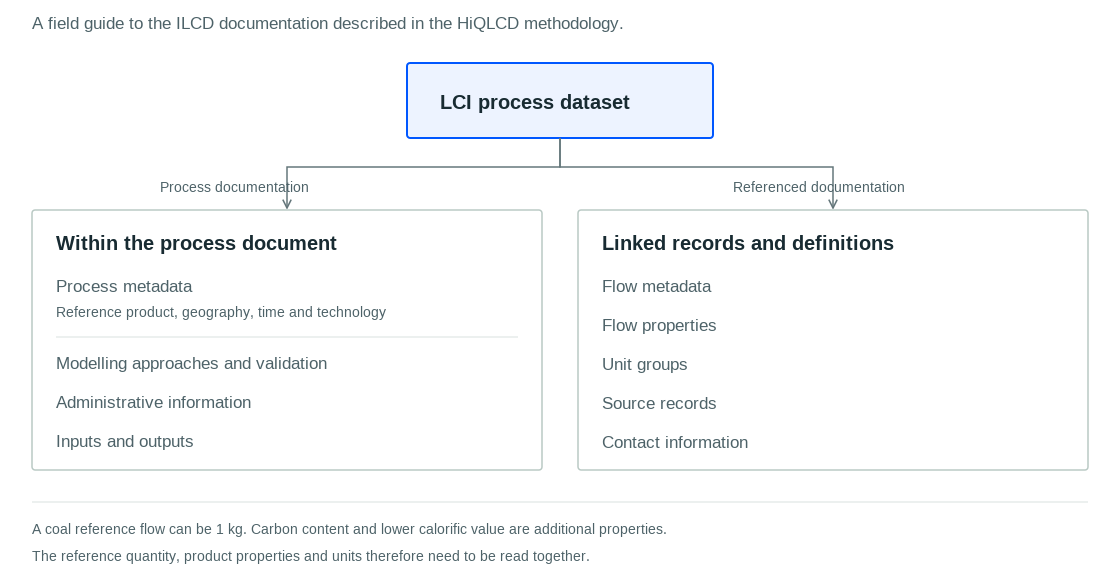
HiQLCD uses the International Life Cycle Data System (ILCD) format for dataset documentation and exchange. For an aggregated LCI dataset, process metadata describe the activity, modelling approaches and validation, administrative information, and inputs and outputs. Associated records contain flow metadata, flow properties, unit-group data, sources, and contacts.
| Documentation layer | What to consult |
|---|---|
| Process metadata | Reference product and quantity, location, temporal coverage, technology, and scope. |
| Modelling and validation | System boundary, allocation or substitution, processing assumptions, data quality, and verification information. |
| Administrative information | Dataset identification, authorship, responsibility, and associated contact information. |
| Inputs and outputs | Resources, materials, energy, products, by-products, wastes, and emissions for the represented process. |
| Linked flow and unit records | Flow identity, physical properties, reference quantities, and units. |
| Source and contact records | The evidence and responsible parties supporting traceability. |
To trace an exchange, start with the process and its reference flow, then use the linked flow and unit-group records to interpret the exchanged quantity and its properties. Use modelling and validation information to understand how the process was constructed, and source and contact records to trace evidence and responsibility.
Mixing methodology, weights, sources, assumptions, and adjustments explain how a dataset is constructed; multi-source aggregation protects individual company information. Access to underlying records and rights to redistribute data follow the applicable delivery and licence terms.