
Three System Models
| Short name | Full model name | Main distinction |
|---|---|---|
| Cut-off | Allocation, Cut-off by Classification | Attributional allocation and product-level classification; primary production, recyclables, and waste treatment are separated at the specified cut-off. |
| Consequential | Substitution, Consequential | Equivalent-product substitution using the methodology's average-market approximation; allocation remains applicable between specified joint-production reference products. |
| EN15804 | Allocation, Cut-off, EN15804 | Attributional model with the primary/secondary boundary adjusted to end-of-waste criteria, together with the corresponding inventory indicators and biogenic carbon information. |
Choose the system model for the study's goal and apply its rules consistently across connected datasets. The same material or treatment name can have different flow classifications, reference flows, and burden transfers in different models.
HiQLCD stores unlinked unit-process data as multi-output records. Inputs in these records identify products rather than supplying activities; the selected system model provides the linking and multi-output rules for deriving linked, single-output datasets. The original and derived datasets share the same Universally Unique Identifier (UUID), so record the model as well as the identifier.
Cut-off: Product Classification
All intermediate exchanges in the database are classified - at the product, not activity, level - as allocable product, recyclable, or waste. This classification dictates how each flow is handled during allocation.
| Classification | Definition in the Cut-off model |
|---|---|
| Allocable product | Ordinary co-products with economic value that participate in allocation. |
| Recyclable | Materials with no or low economic value that can be inputs to recycling, such as metal scrap and waste paper. |
| Waste | Materials with no or negative economic value requiring disposal services, such as wastewater, contaminated soil, and radioactive waste. |
Cut-off: Multi-Output Processes
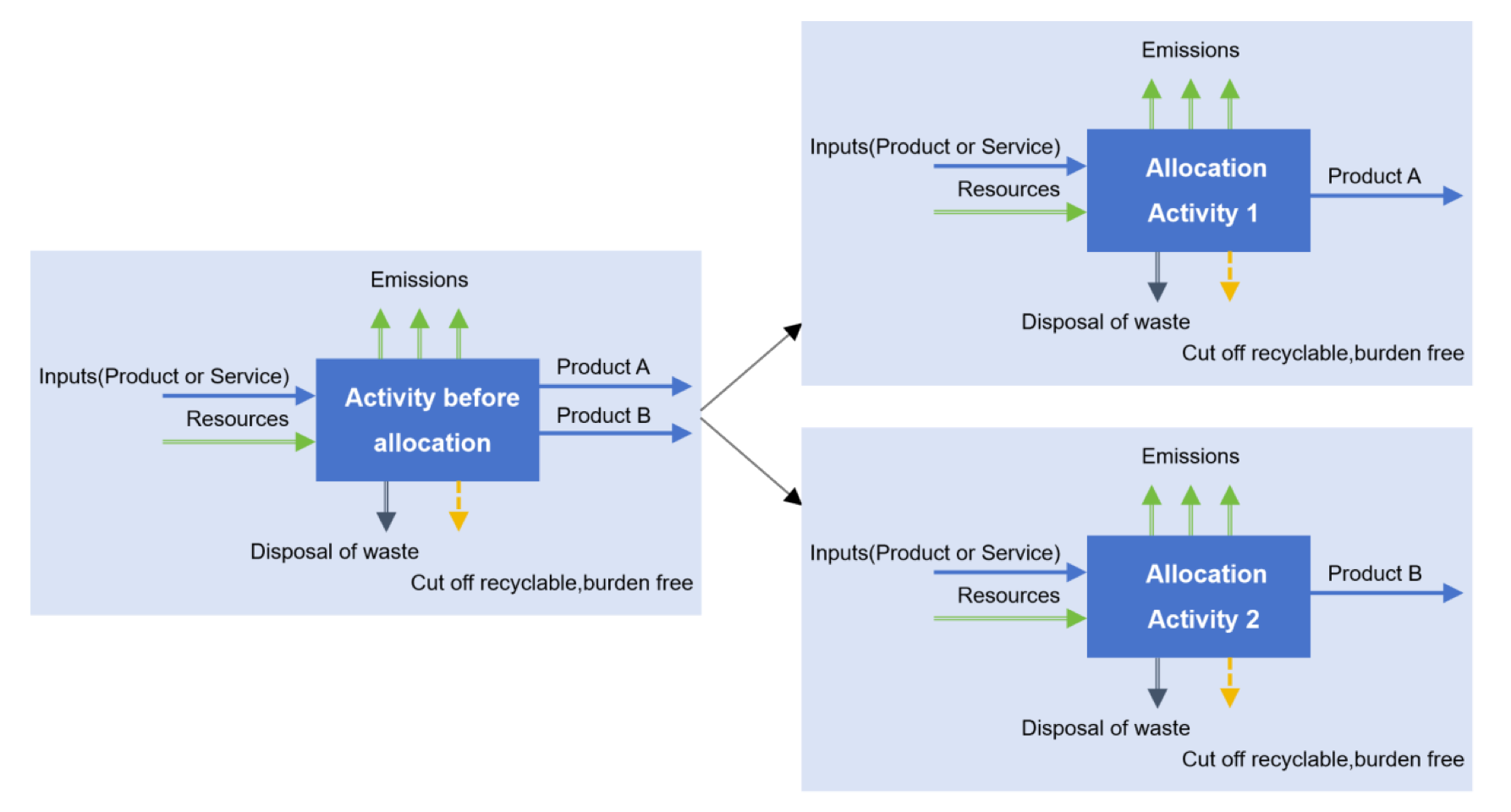
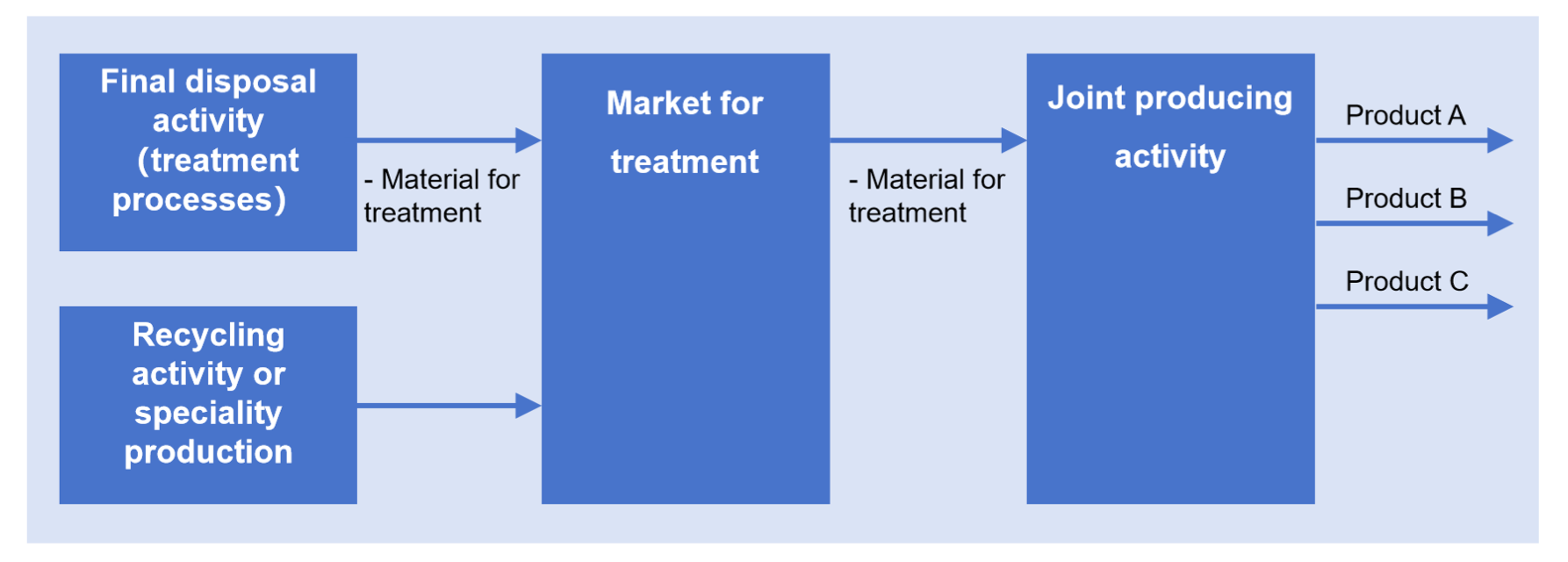
A balance check precedes allocation of the activity's inputs, emissions, and intermediate flows. Recyclable and waste flows are shifted to the input side; the remaining co-products are allocated using their defined factors. Economic allocation is the default where no process-specific rule applies, with the exceptions set out in the allocation reference.
Cut-off: Reuse and Recycling Chains
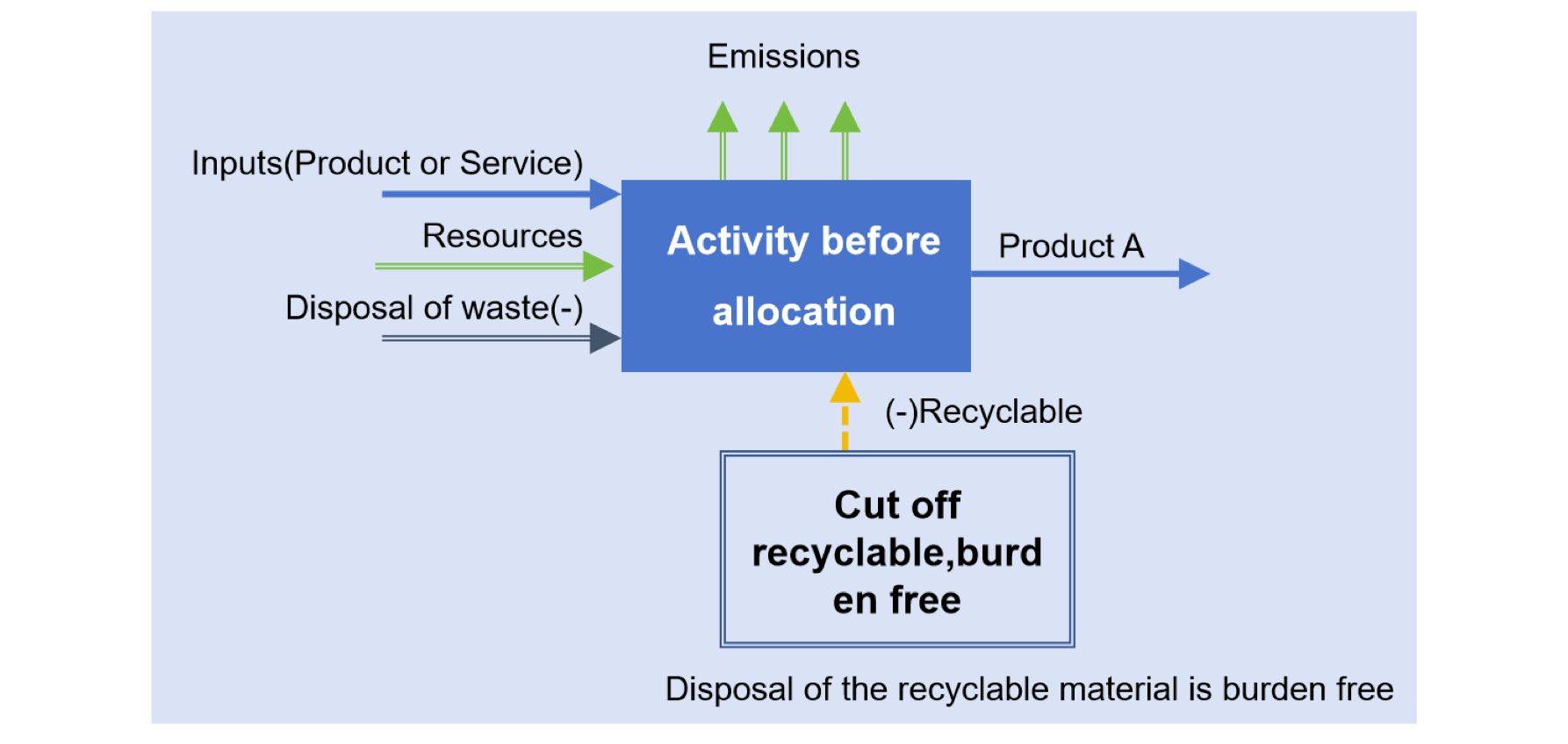
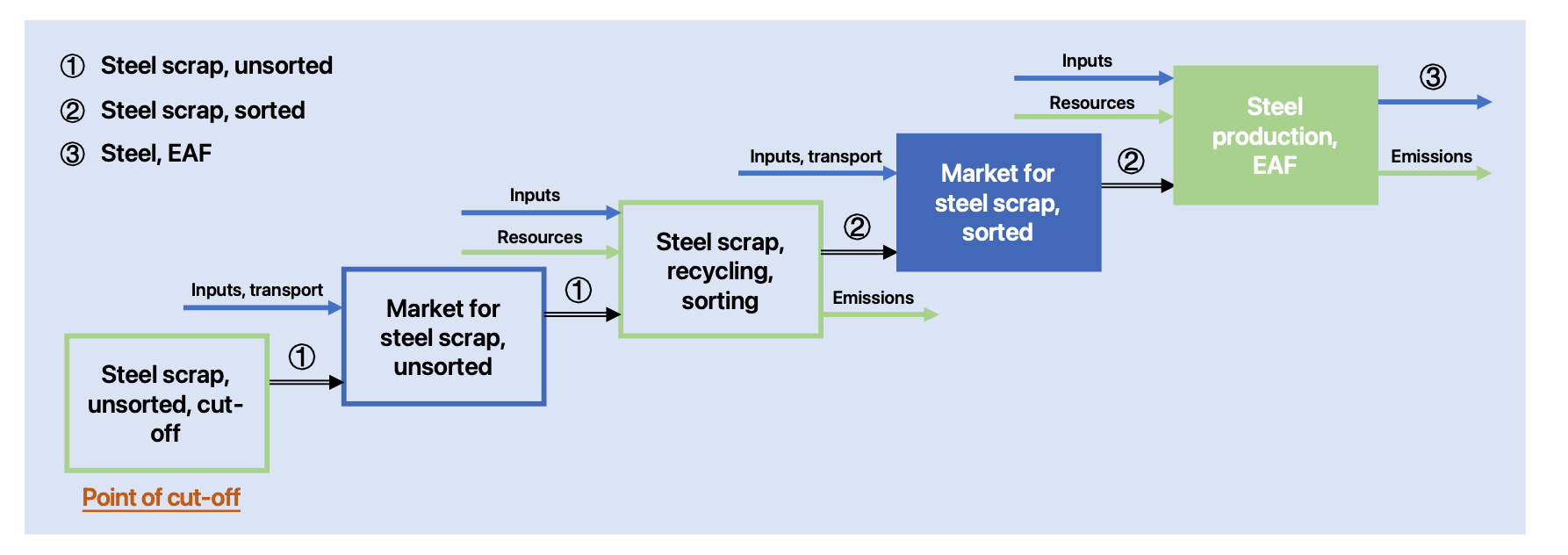
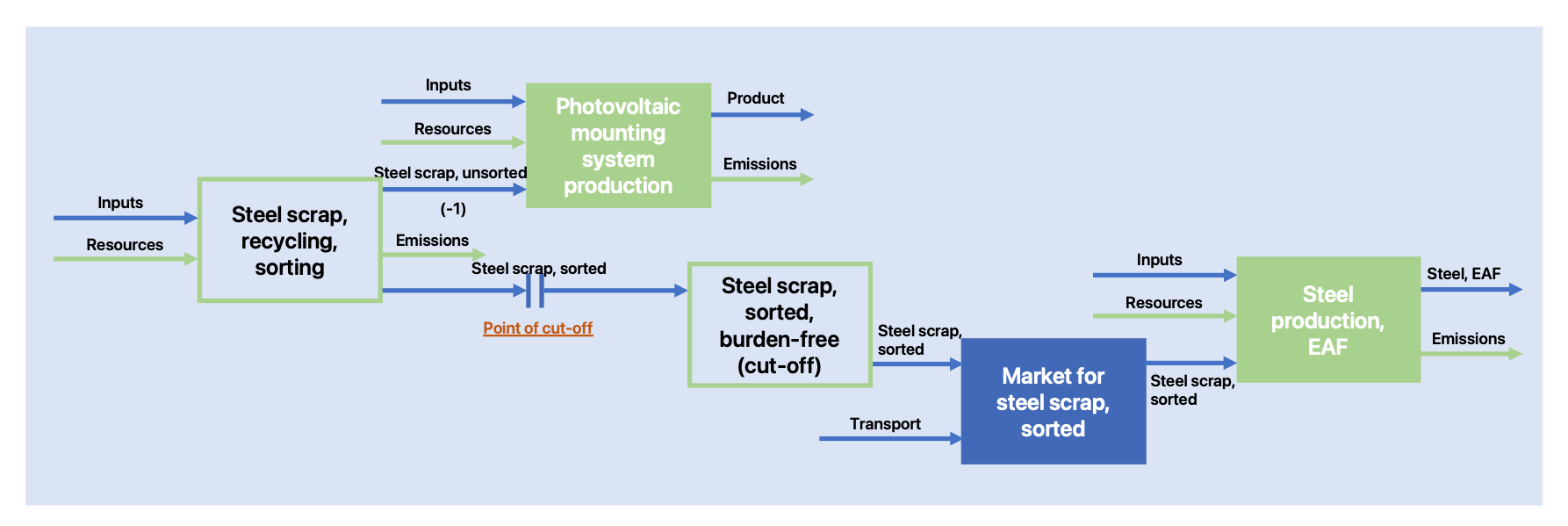
Recyclable outputs are disconnected from primary production by referencing a special "Product Name, Cut-off" dataset, which contains no inputs or emissions (burden-free). In the primary production activity, the recycled output is recorded as a negative input, pointing to an empty cut-off process.
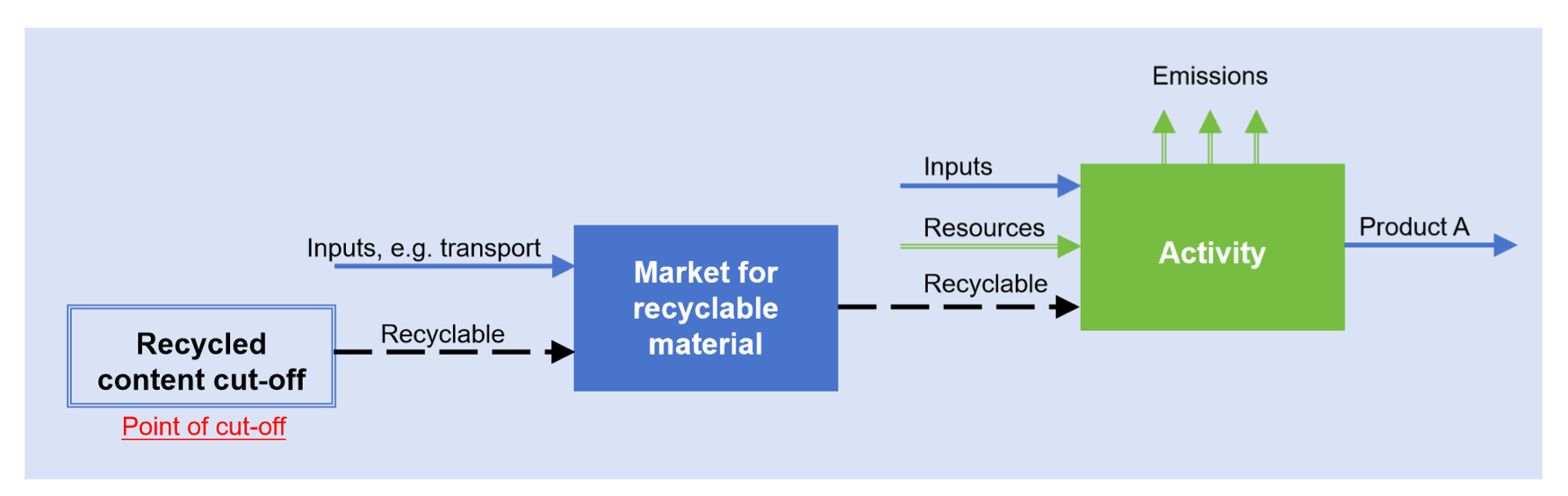
The cut-off occurs when the recyclable material leaves the primary production stage. Downstream recycling processes draw from a market linked to the burden-free recycling dataset.
The recycling chain itself is still modelled. In the scrap example, unsorted post-consumer scrap undergoes collection and sorting before entering a sorted-scrap market and an electric arc furnace process. Although both material forms are cut off from primary-production burdens, the sorted-scrap supply chain traces back to the initial collection stage. Collection, sorting, transport, and recycling are not erased by calling the scrap burden-free at the cut-off.
Cut-off: Waste Treatment and Valuable Outputs
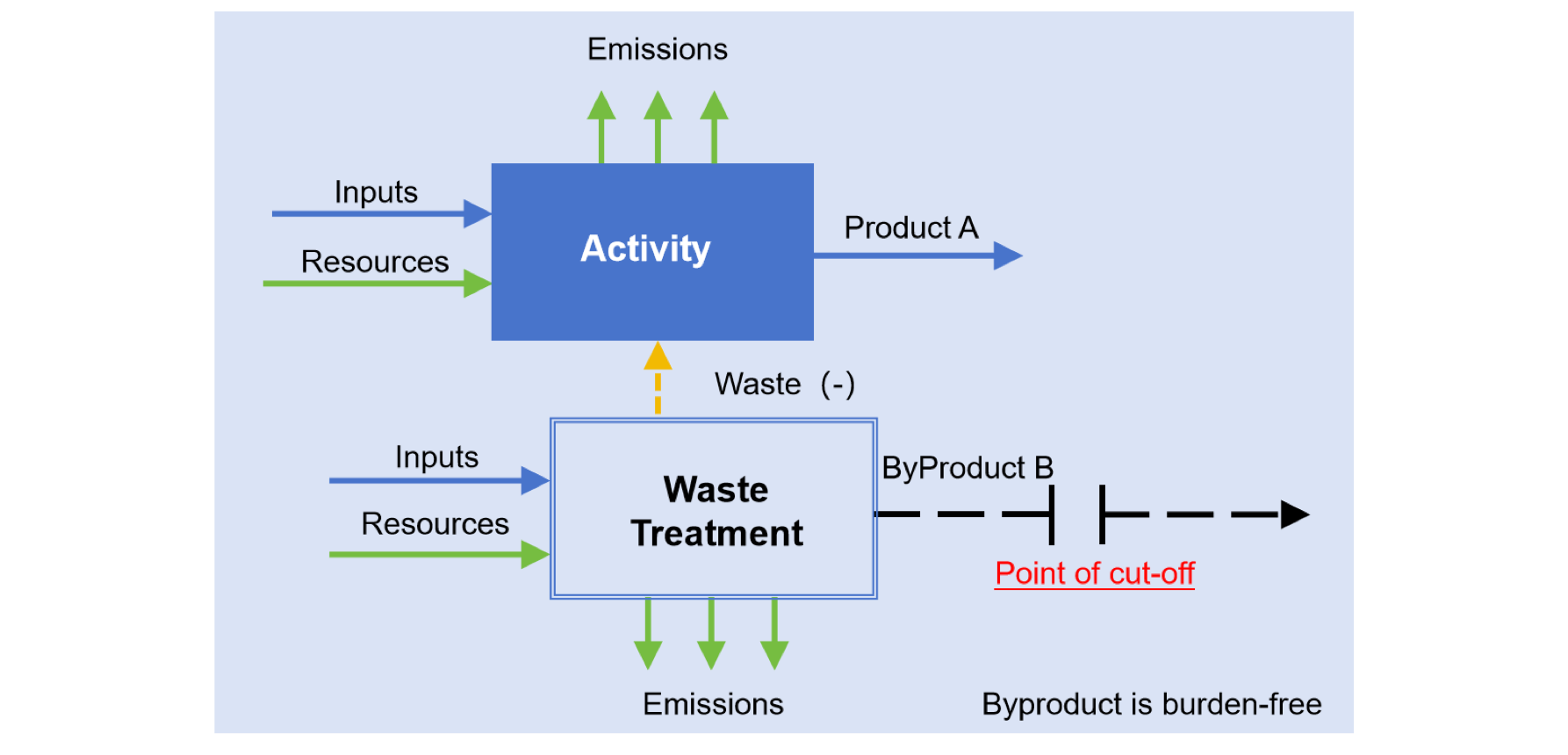
Waste outputs are modelled as negative inputs to represent the need for waste-management services. The inputs and emissions of treatment are allocated back to the waste-generating activity. Non-waste by-products with residual value are cut off at the end of treatment and become available to another system. Their benefits are not allocated back to the waste producer; for example, heat recovered from municipal waste incineration does not provide a substitution credit to the producer in this model.
Consequential: Purpose and Equivalent Substitution
The methodology uses this model for micro-level decision support and what-if analysis under the assumption that the substituted outputs do not cause large-scale changes in installed capacity or structurally change the background system. Its substitution rules use a simplified market approximation rather than the identification of the most likely superseded processes required by full consequential modelling.
Functional differences between a co-product and the product it supersedes must be reflected in the substituted quantity. The preferred basis is the amount actually superseded, such as the amount of Portland cement actually replaced by basic oxygen furnace (BOF) slag. As a second priority, the amount and inventory of the substituted function can be corrected using the ratio between their market prices. Equal mass is not assumed to provide equal function.
Consequential: A Single Reference Product
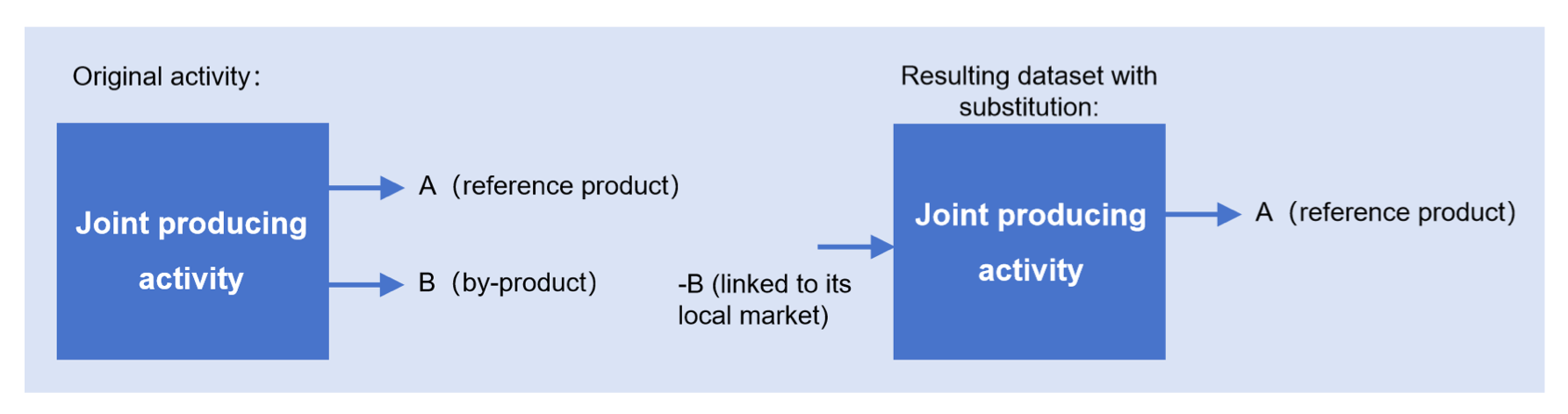
When a process has only one main reference product and additional outputs are considered non-reference co-products, these co-products are modelled as negative inputs. The core process retains all direct inputs and emissions. The environmental burden is assigned solely to the reference product, while the co-products are modelled to replace equivalent products on the market.
Where functionally equivalent alternatives are operated or produced to a sufficient extent, substitution uses the average market consumption mix of the superseded processes or products, excluding the process route or product being substituted. The negative input connects to the corresponding market rather than retaining the co-product's link to its original producer.
Consequential: Joint Production
Joint production distinguishes multiple main reference products from additional by-products. For multiple equally important reference products, such as crude oil and natural gas or lead and zinc concentrates, the methodology specifies allocation among the reference products. Depending on the study goal and technical relationships, that allocation can use physical properties, such as mass, or economic value. Annex A also lists physical allocation properties for specific Consequential processes.
For an activity with more than one reference product, the methodology describes duplicating the multi-product dataset into the corresponding number of activities, handling each reference product separately. Additional by-products beyond the main reference products are modelled as negative inputs substituting market equivalents. Apply the documented process-specific allocation and substitution objects rather than treating this model as universally allocation-free.
Consequential: Waste Treatment and the Substitution Market
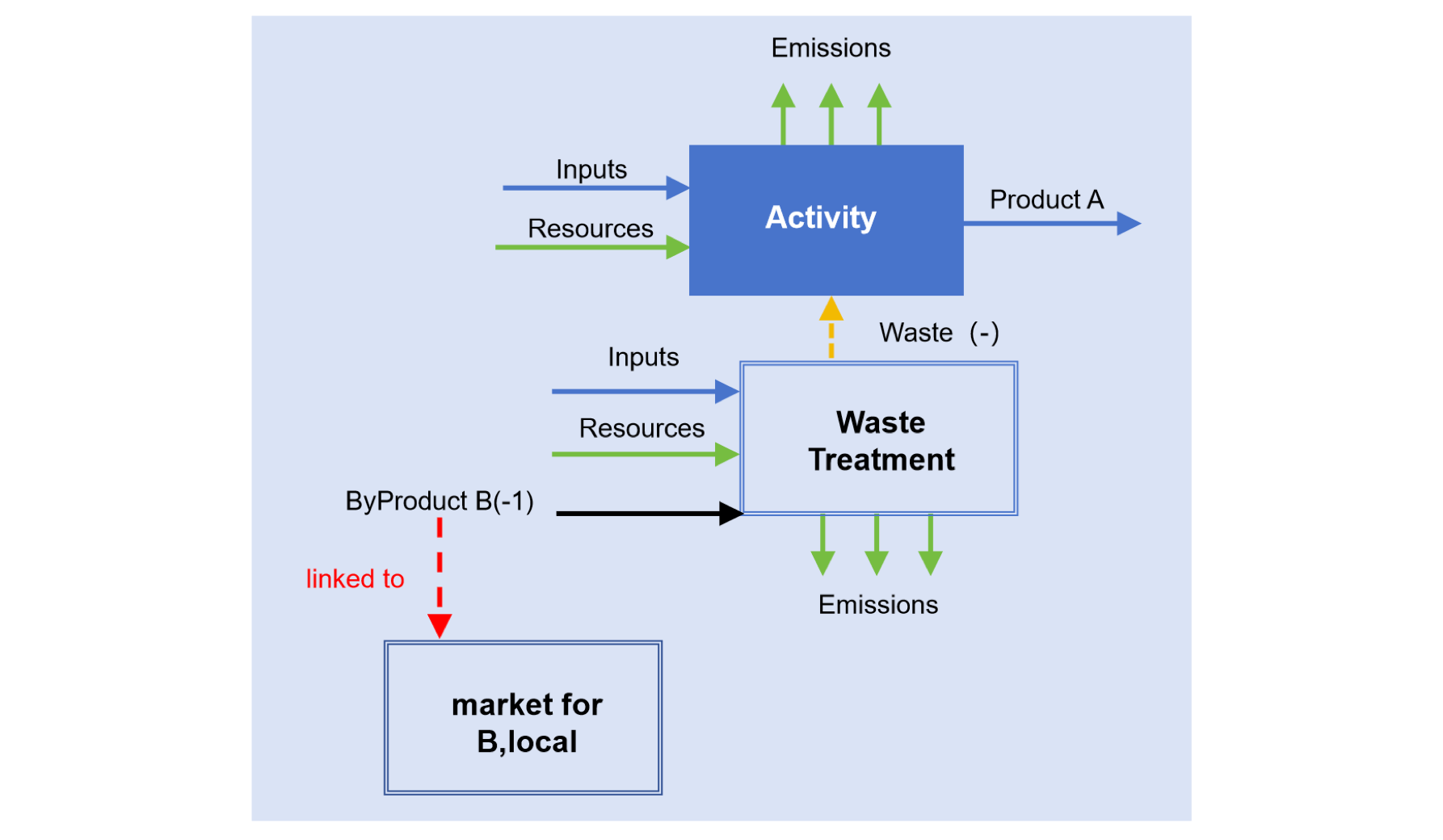
In the “Substitution, Consequential” system model, both recyclable and non-recyclable waste are treated as burdens that require processing. All environmental impacts of the waste treatment process are assigned to the activity that generated the waste.
If valuable by-products are recovered during treatment - such as electricity generated from waste incineration - these are modelled as negative outputs, replacing equivalent market products.
For waste and end-of-life treatment, avoided primary production uses the average primary-route market mix where the secondary good is produced. Functional differences are addressed through actual superseded quantities or market-value correction. For recovered electricity, the substituted mix is that of the country, region, or sub-grid where treatment takes place, excluding the electricity source being substituted.
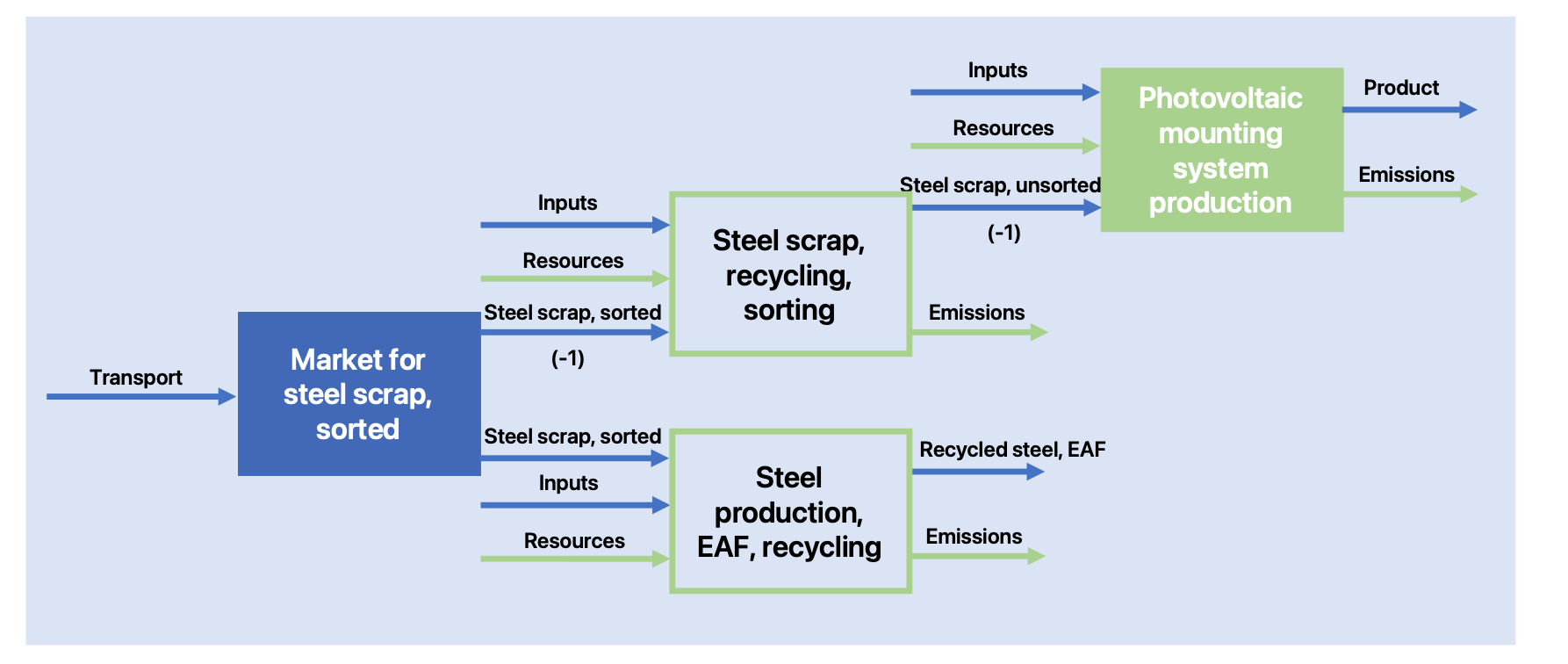
The methodology's steel-recycling example follows unsorted scrap from a photovoltaic mounting system through collection, sorting, a sorted-scrap market, and electric arc furnace recycling. The recycled steel substitutes primary steel in the example's global market, and the resulting avoided-production credit is traced back to the PV mounting system that supplied the scrap. The global steel market belongs to that example; the general market-selection rule remains tied to the secondary good and its place of production.
EN15804: End-of-Waste and the Primary/Secondary Boundary
The “Allocation, Cut-off, EN15804” system model belongs to the attributional system. This system model was developed to meet the needs of Environmental Product Declaration (EPD) practitioners.
The model retains product-level classification and the polluter-pays principle, but adjusts the cut-off between the primary and secondary systems according to end-of-waste criteria. Classification changes can therefore be needed when the cut-off point changes. The methodology refers to EN15804&A2:2019, ISO 21930, and ISO 14025 in describing this modelling approach.
A recovered material reaches its end-of-waste state when the following four conditions are met:
- the recovered material, product or construction element is commonly used for specific purposes;
- a market or demand, identified e.g. by a positive economic value, exists for such a recovered material, product or construction element;
- the recovered material, product or construction element fulfils the technical requirements for the specific purposes and meets the existing legislation and standards applicable to products;
- the use of the recovered material, product or construction element will not lead to overall adverse environmental or human health impacts.
Waste treatment processes are in general part of the primary product system, based on the “polluter pays” principle. Further processing that may be required after the material has reached its end-of-waste state does not belong to the primary system. For example, in the “Allocation, Cut-off, EN15804” system model, recycling activities of metals at the refinery or the remelting furnace are beyond this end-of-waste state.
The exact end-of-waste point depends on the material's composition and properties. Mixing a material that has not yet reached this state with raw materials undergoing chemical transformation can require case-specific separation between treatment and product manufacture. The generic database uses assumptions for these cases; consult the process documentation for the boundary applied.
EN15804: The Steel-Scrap Sorting Example
| Feature | Allocation, Cut-off by Classification | Allocation, Cut-off, EN15804 |
|---|---|---|
| Unsorted iron scrap | Classified as recyclable. | Classified as waste; sorting brings it to a recyclable product with a market and properties meeting the technical specifications. |
| Reference flow for "Steel scrap, recycling, sorting" | "1kg Steel scrap, sorted" | "-1kg Steel scrap, unsorted" |
| Meaning of the reference | Sorted scrap output. | Unsorted scrap input to be treated; the negative sign expresses the treatment-side convention. |
| Burden transfer | Primary-production burdens are cut off under the classification model; the recycling chain remains modelled. | Sorting belongs before the adjusted end-of-waste cut-off; further recovery processing after that state belongs outside the primary system. |
EN15804: Multi-Product Allocation
After recyclable and waste flows are shifted to the input side, the remaining allocable products are allocated according to their defined factors under the EN15804 rules. In the methodology's examples, blast furnace slag and fly ash that contribute minimally to the producing activity's revenue are not allocated impacts from that producing activity. Further processing and supply remain subject to their own process boundaries.