
Versions, Reproduction, and Use
Update Types
| Update type | HiQLCD update policy (effective 15 December 2025) |
|---|---|
| Regular dataset update | Approximately every six months during the rapid-expansion phase, moving to an annual schedule once the database stabilizes. |
| Maintenance update | Corrections such as error fixes, released as needed. |
| Major upgrade | Significant architectural changes planned every few years. |
| Methodology update | The methodology is updated when new or updated data are incorporated into a new HiQLCD release. |
A database release date, a dataset reference period, a source-data year, and an LCIA method version identify different things. Keep them separately when recording a calculation. Updating a method or a file does not by itself change the period represented by the inventory.
Why a Background Update Can Change Results
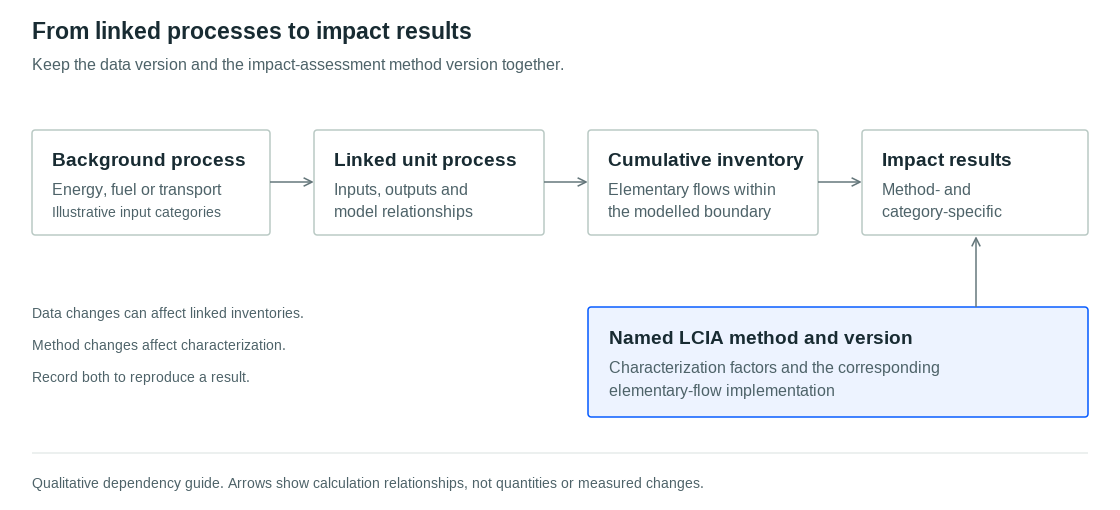
Electricity, materials, and infrastructure inputs link to their suppliers in the inventory network. A change in an electricity supplier inventory, for example, can change the cumulative inventory of a connected process even when its own direct electricity input is unchanged. The magnitude of the effect depends on the linked processes and the size of the change. To compare impact results across versions, check the background release as well as the impact assessment method and its variant.
Reproduction and Citation Record
For a reproducible calculation and an identifiable citation, retain the following information with the study:
| Record | Information to retain |
|---|---|
| Database and delivery | HiQLCD; the data product or package used; database release; dataset identifiers and versions where provided. |
| Model | The full system model name and the treatment of connected background data. |
| Reference and scope | Reference product, quantity, unit, geography, time coverage, technology, and boundary. |
| Impact calculation | LCIA method, version, and variant, together with the calculation environment and settings used in the study. |
| Quality evidence | Relevant source references, individual DQI grades and basis, uncertainty information used, and review records applicable to the selected data. |
| Access | Date obtained and the delivery or licence scope under which the data were used. |
Use these fields to identify the datasets and methods used in your study. Follow any citation instructions supplied with the delivery and keep them with the dataset documentation.
Delivery and Licensed Scope
Confirm the data product, release, included datasets, system models, and format against the selected delivery. Check separately whether an independently named sector product is included. A count of records spanning several system models is not a count of distinct products, and a product's availability in one model does not establish its availability in another.
Distinguish publication of calculated LCA or footprint results from redistribution of the underlying inventory. Appropriate attribution does not by itself grant permission to supply reusable data to another party. Commercial work, teaching groups, software integration, redistribution, and AI or machine-learning use should be checked against the licence and written authorization applicable to the delivery.
Generic Methodology Report
HiQLCD Database Generic Methodology Report Effective date: 15 December 2025. Applies to: HiQLCD data, irrespective of database release. Confirmed by the HiQLCD data-group lead; reviewed by Prof. Guido Sonnemann as a third-party methodology reviewer. Contents: goal and scope; data collection and validation; inventory modelling; system models; data quality; review; nomenclature and documentation; allocation exceptions. Methodology PDF (English)