
Review and Quality Assurance
Review Roles
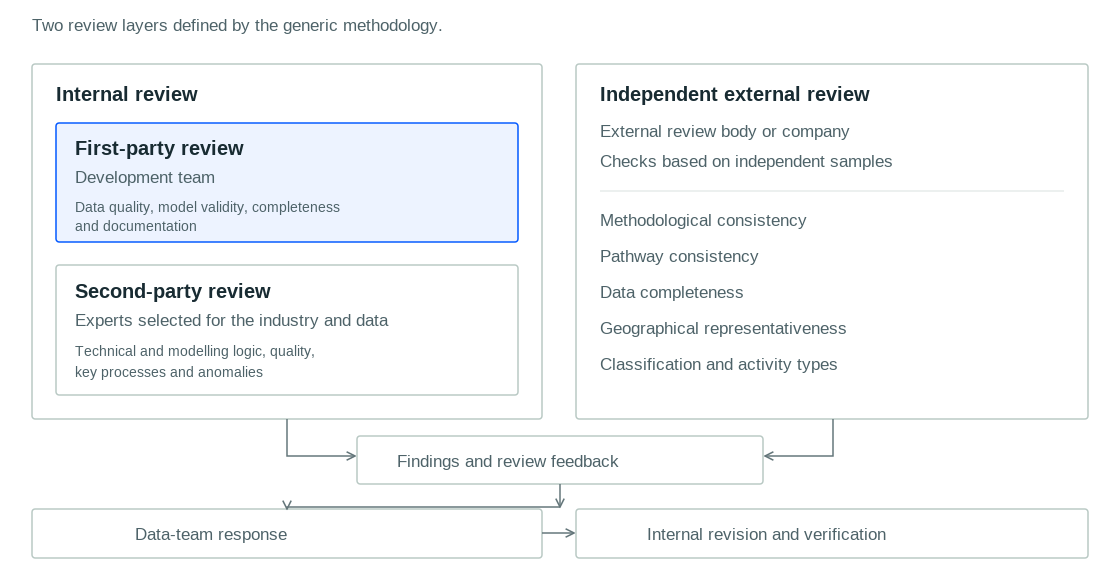
First-party and second-party reviews form the internal review layer. The database development team checks data quality and model integrity in first-party review. Second-party reviewers examine sector-specific issues and the scientific validity of the models; experts are selected for the industrial domain, data type, intended use, and model complexity. Independent external review is a separate layer.
The number of second-party reviewers is needs-driven: sufficient domain expertise is required, with no predefined numerical cap. Plausibility and error checks address both unit processes and the supply chain. For typical processes, standards, industry reports, peer-reviewed publications, and comparable databases provide cross-check information. New or updated data are checked against existing or comparable datasets on a case-by-case basis.
Technical Reference: First-Party Internal Review
| Area | Check | What is examined |
|---|---|---|
| Data quality control | Background data selection | Source reliability; consistency with system boundaries and technological processes; sufficient geographic, temporal, and technological representativeness. |
| Data quality control | Data and unit consistency | Harmonization of foreground and background data; consistent units and measurement methods for material and energy flows. |
| Data quality control | Data completeness | Coverage of inputs and outputs without omission of key flows. |
| Data quality control | Data accuracy and precision | Reliable sources, acceptable margin of error, and accurate measurement methods. |
| Data quality control | Uncertainty analysis | Sufficiency and reasonableness of uncertainty analysis and impact sensitivity analysis. |
| Model validity and rationality | System boundaries | Comprehensive definition and clear description of the product-system boundary. |
| Model validity and rationality | LCI modelling methodology | Consistency with LCA principles; sound parameters, formulas, and logical relationships. |
| Model validity and rationality | Mass and energy balance | Conservation of mass, energy, and elements; reasonable input/output balances. |
| Model validity and rationality | Functional unit / declared unit | Clear definition and consistency with ISO standards, industry guidelines, or applicable PCRs. |
| Model completeness | Emission profiles and cut-off points | Unmodelled emissions, unlinked upstream or downstream processes, and missing transport or waste treatment. |
| Model completeness | Energy and resource output modelling | Inclusion of surplus heat, steam, electricity, energy recovery, and material-recycling inputs, avoiding overstated benefits. |
| Documentation | Data source referencing | Identified data provider or responsibility for the dataset. |
| Documentation | Nomenclature consistency | Unified naming for materials, energy flows, and processes, avoiding ambiguity and duplication. |
| Documentation | Resource, emission, and energy-flow documentation | Complete records with explicit units and attributes. |
| Documentation | Process background, data sources, and references | Necessary background information and reliable references supporting verification and reuse. |
| Documentation | Referencing style | Consistent documentation and data-citation formats. |
Technical Reference: Second-Party Internal Review
| Area | Check | What is examined |
|---|---|---|
| Data quality control | Background data selection | Reliable sources and appropriate system boundaries and geographic, temporal, and technical scope. |
| Data quality control | Data and unit consistency | Harmonized foreground/background data, units, and measurement methods for materials and energy. |
| Data quality control | Data completeness | Full input/output coverage without missing key data or boundary gaps. |
| Data quality control | Data accuracy and precision | Reliable sources, acceptable margin of error, and accurate measurement methods. |
| Data quality control | Uncertainty analysis | Whether uncertainty and sensitivity analyses have been conducted. |
| Data quality control | Technological status | Whether the model reflects advanced, conventional, mature, pilot, or laboratory conditions. |
| Data quality control | Process integration | Whether a process is independent or embedded in another system. |
| Data quality control | Average or specific values | Whether data describe industry averages or particular enterprises or installations. |
| Data quality control | Critical processes | Accurate representation of the main production steps at the modelling level. |
| Data quality control | Reactants and products | Complete and reasonable types and quantities with consistent units. |
| Data quality control | Reaction efficiency and yield | Reaction pathways consistent with theory and practice and realistic yields. |
| Data quality control | By-products, wastes, and residues | Modelled destinations for recycling, treatment, or release. |
| Data quality control | Looping flows | Inclusion and continuity of internally recycled materials and other loops. |
| Data quality control | Auxiliary materials and utilities | Coverage of inputs such as steam, water, and electricity. |
| Data quality control | End-of-pipe treatment | Realistic pollution-control inputs such as lime and ammonia. |
| Model validity and rationality | Technological status and process logic | Representation of actual processes or industry-average conditions. |
| Model validity and rationality | Industry-specific allocation | Correct use of the industry's allocation methods and co-product treatment. |
| Model validity and rationality | Substitution assumptions | Consistency with industry logic, for example recycled aluminium substituting primary aluminium. |
| Model validity and rationality | Co-product and system expansion modelling | Appropriate allocation, substitution, and system expansion. |
| Model validity and rationality | Energy balance: LHV/HHV | Correct representation of electricity, heat, and fuel inputs on the applicable lower/higher heating value basis. |
| Model validity and rationality | Mass balance | Equality of inputs and outputs and conservation of total mass. |
| Model validity and rationality | Element balance | Conservation of carbon, metals, and other key elements, including recycling flows. |
| Model validity and rationality | Chemical reaction equations | Balanced equations consistent with the actual process. |
| Model validity and rationality | Waste and recycled-material methods | Waste not mistaken for primary material; recycling processes consistent with industry practice. |
| Abnormal-data review | Functional unit | Clear definition consistent with the relevant ISO requirements. |
| Abnormal-data review | System boundary integrity | Connections to upstream extraction and other processes, without discontinuities. |
| Abnormal-data review | Fuel modelling defects | Fuel use accompanied by the relevant combustion emissions. |
| Abnormal-data review | Transport modelling | Distances reflecting actual or typical conditions. |
| Abnormal-data review | Substitution | Reasonable recycling and co-product modelling. |
| Abnormal-data review | Wastewater treatment | Inclusion of wastewater and its treatment. |
| Abnormal-data review | Secondary-material modelling | Recycled material not incorrectly treated as burden-free throughout its processing chain. |
| Abnormal-data review | Co-product allocation / system expansion | Appropriate application without introducing irrelevant functions. |
| Abnormal-data review | Energy outputs | Correct treatment of steam, residual heat, electricity, and other energy outputs. |
| Abnormal-data review | Waste / residue treatment | Reasonable burdens without treating recycled materials as primary materials or overstating treatment impacts. |
Independent External Review
External review is conducted by an independent external auditing body or company.
Independent external experts assess the data sources, modelling methodology, and documentation quality using independent samples. The HiQLCD team supplies information and responds to comments. The internal quality-assurance team implements corrections, database updates, and expert re-review.
Technical Reference: External Review Checklist
| Area | Check | What is examined |
|---|---|---|
| Methodological consistency | Modelling consistency | Database guidance and ISO 14044 requirements, including allocation, boundaries, cut-off rules, and consistent LCIA application. |
| Methodological consistency | LCIA compatibility | Correspondence between inventory data and the selected methods, such as EF3.1, ReCiPe, or CML. |
| Pathway consistency | Supply-chain coverage | Traceability to raw-material extraction and primary energy, without missing upstream links. |
| Pathway consistency | Background-data references | Electricity, transport, fuels, and other background inputs from the same database version with consistent sources. |
| Pathway consistency | Technical pathway logic | Continuous reactions, separations, and treatment stages without skipped or illogical connections. |
| Data completeness | Mass and energy balance | Balanced inputs and outputs, including before and after allocation; abnormal losses and missing data. |
| Data completeness | Flow coverage | Major raw materials, energy, water, emissions, co-products, by-products, and waste. |
| Data completeness | Metadata | Units, time, region, technology, sources, and modelling assumptions. |
| Data completeness | Emissions and waste | Important flows such as CO2, NOx, wastewater, and solid waste, together with their treatment. |
| Geographic representativeness | Regional background | Target-region electricity, technology, and regulatory context. |
| Geographic representativeness | Regional flows | Background transport and electricity matched to the target region rather than defaulting to global data. |
| Geographic representativeness | Cross-regional treatment | Appropriate handling of multi-region data and consistent export/import logic. |
| Classification and activity type | ISIC/NACE classification | Classification corresponding to the technological activity, without errors affecting filtering or allocation. ISIC is the International Standard Industrial Classification; NACE is Nomenclature statistique des activités économiques dans la Communauté européenne (the statistical classification of economic activities in the European Community). |
| Classification and activity type | Activity labels | Accurate identification as energy, material, process, or another applicable type. |
| Classification and activity type | Industry-review alignment | Assignment to the relevant industry review team and activity scope. |
Reviewer Qualifications
| Role | Qualification required by the methodology |
|---|---|
| Domain expert | At least five years of professional experience, proficiency in the relevant technologies, production routes, and environmental impact assessment, and the ability to analyse complex datasets. |
| LCA expert | Five years of specialized LCA experience, a theoretical foundation, familiarity with the relevant products or processes, and the ability to identify technical issues and inconsistencies. |
Typically, the review is conducted by a paired team consisting of at least one LCA expert and one domain expert.